Writing
Never Trust A Hotel Review
As most people probably do, we always ensure we check reviews before we book to stay somewhere. A bit of due diligence before parting with hundreds of pounds is surely a reasonable thing to do?
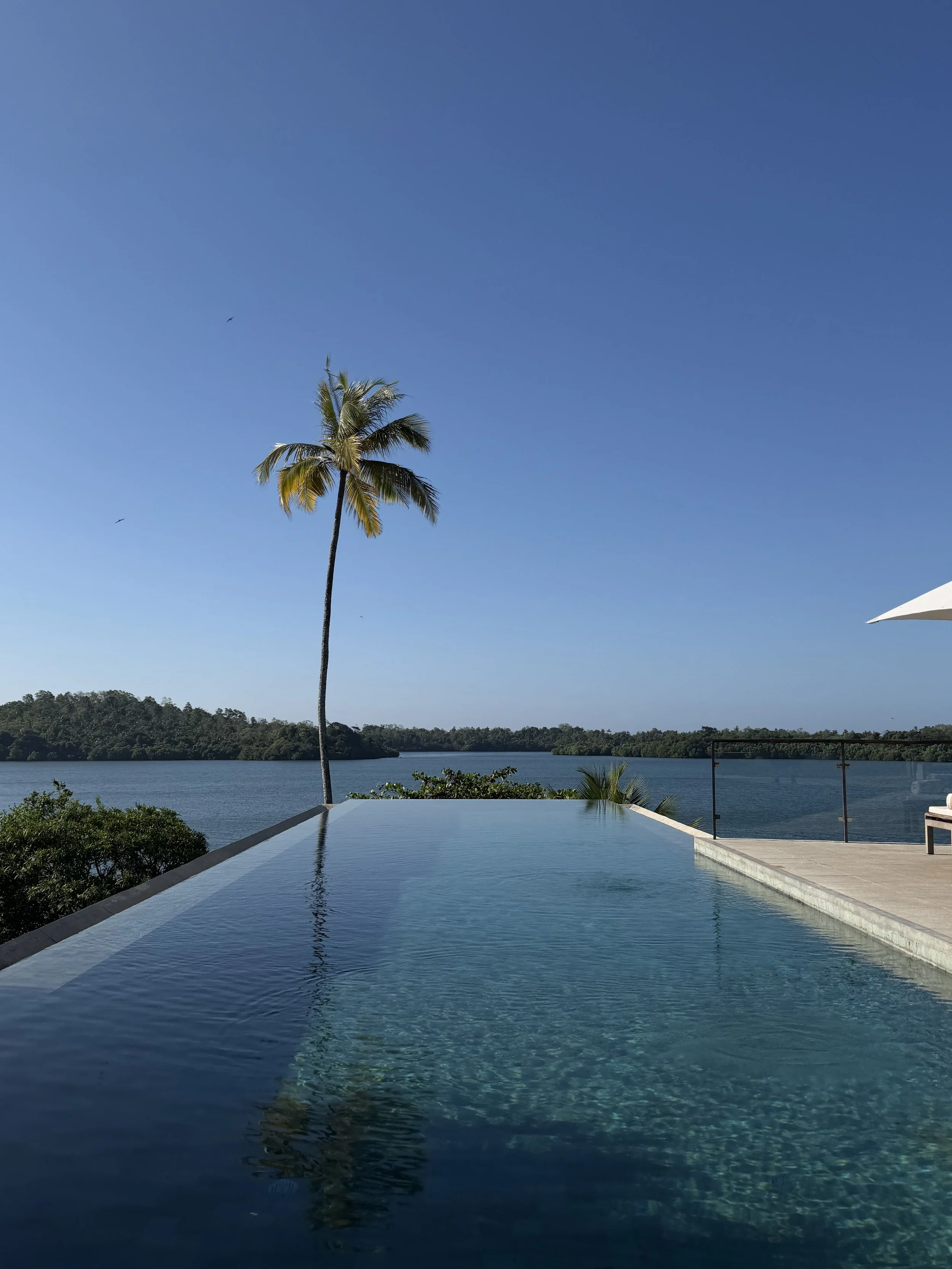
However, one thing I’ve become aware of having stayed in such a large number of places, in a short period of time, is that you can never trust a hotel review.
One person’s idea of a delicious breakfast, was my idea of what you’d imagine getting served as an inmate in a South American prison.
A tropical paradise - surprising one guest who was shocked to find one insect.
Likewise, someone’s horror story 1 star review, just because they found an insect (in what is effectively a jungle), leaves me wondering why they wanted to holiday amongst nature at all.
Or negative feedback for a hotel, because the nearby sea, yes that natural force of nature, had too many waves.
These are extremes of course, but I’ve also seen many 10/10 booking.com reviews where people have then gone on to add some negative feedback and it leaves me wondering why some people don’t understand the concept of scale.
Surprisingly no mentions of the toilet being in the shower cubicle, for this hotel.
So here’s the part I’m meant to tell you what you should do to avoid any disappointments. A list of hacks. A top 10 list for guaranteeing a perfect stay every time.
The problem is that there is no magic formula. Travel inevitably involves discomfort, compromise and occasionally realising that your idea of somewhere doesn’t quite match reality.
The longer we travel, the more I realise people are often reviewing their own expectations as much as the hotel itself.
Hotel reviews tell you less about the hotel than the person writing them.
If you enjoyed this, you might like the below too…
One Last Push
My legs tighten. One last push. Over another bump in the gravel and the climb finally gives way, opening out into a plateau. A stretch of green rice fields ahead, the sun catching on the flooded plains. Zebra doves make their mechanical whirring sound overhead as a worker in a conical hat walks past.
It feels like I’m in a film. And yet, somehow it is exactly as you’d expect it to feel in a place like this. Early morning mist lifting above the tree line. Mount Rinjani sitting behind it all, fixed against a big blue sky.
Mount Rinjani looming large, Tetebatu.
We cycle through small villages where children run out to greet us. Smiling and waving with the kind of enthusiasm you don’t question at that age.
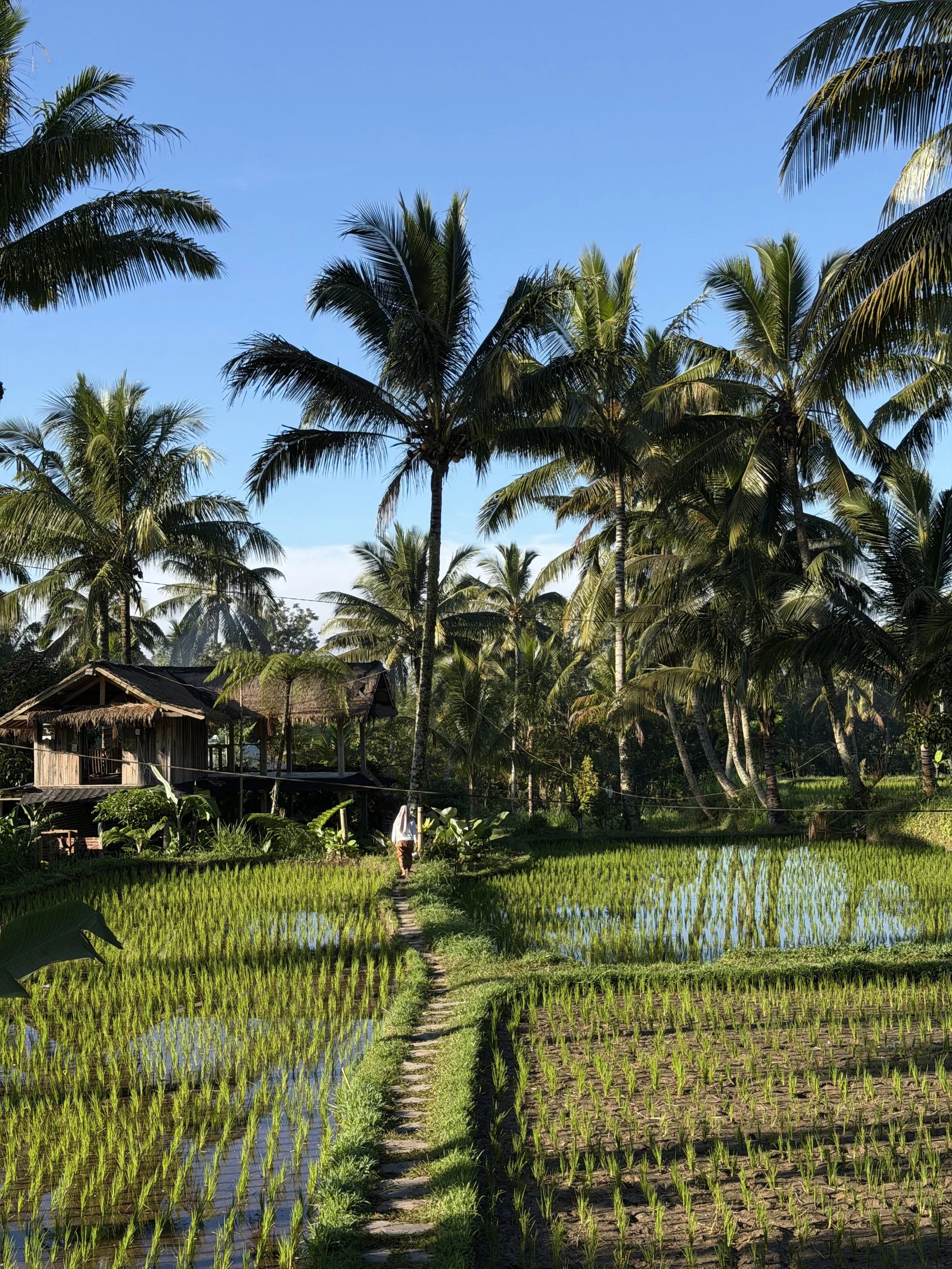
Back into the fields and another scene opens up. A narrow dirt path raised between paddies, water on either side. Palm trees line the horizon. A small thatched house sits just ahead. A woman walks along the path, and it stops feeling like a film set, to something lived.
The tempo is slow, meandering, but deliberate. Getting lost feels like the point. There’s always the sense that something might appear just around the next bend.
Tetebatu rice fields, Lombok, Indonesia.
Eventually, we reach Hideaway Coffee - a name that, for once, doesn’t overpromise. It’s tucked away along a narrow pathway off the main road. Past more rice fields, through the edge of someone’s yard, a hen and her chicks scattering as we pass.
We leave the bikes at the top of a steep hill. Where a sign announces we are at the Hideaway, yet it’s nowhere in sight (appropriately). Narrow dirt steps cut through thick greenery. A short walk, a bamboo bridge, and then it opens out into a clearing with terraced levels where the eclectically furnished café sits, blending into its natural habitat. It feels like a natural end point.
We sit with coffee and pick up a book from a nearby shelf about why humans evolved to have a brain.
I look up from the page for a bit and take it all in.
Hideaway cafe - living up to its name.
If you enjoyed this, you might like the below too…
Strong Women - Sukarara weaving village
After enough time on the road, travel stops being about places and starts becoming about perception. Not what you see, but how it quietly rewires what you thought you knew.
After enough time on the road, travel stops being about places and starts becoming about perception. Not what you see, but how it rewires what you thought you knew.
I’ve felt that in many places and I felt it last in Sukarara, a weaving village in Lombok, where our driver pulled in on our way to Tetebatu - rice country.
Lombok is a predominantly Muslim island and before coming here I carried a loose, untested assumption. That women would be less visible. More hidden. That life would feel, in some way, constrained.
It didn’t take long for that to fall apart.
Our guide - Rihanna
We were shown around by our host, who introduced herself as Rihanna. Around her were Beyoncé, Taylor Swift, J.Lo, Ariana Grande. Not names given to them, but names they had chosen themselves, worn lightly, almost as a joke shared with the world passing through.
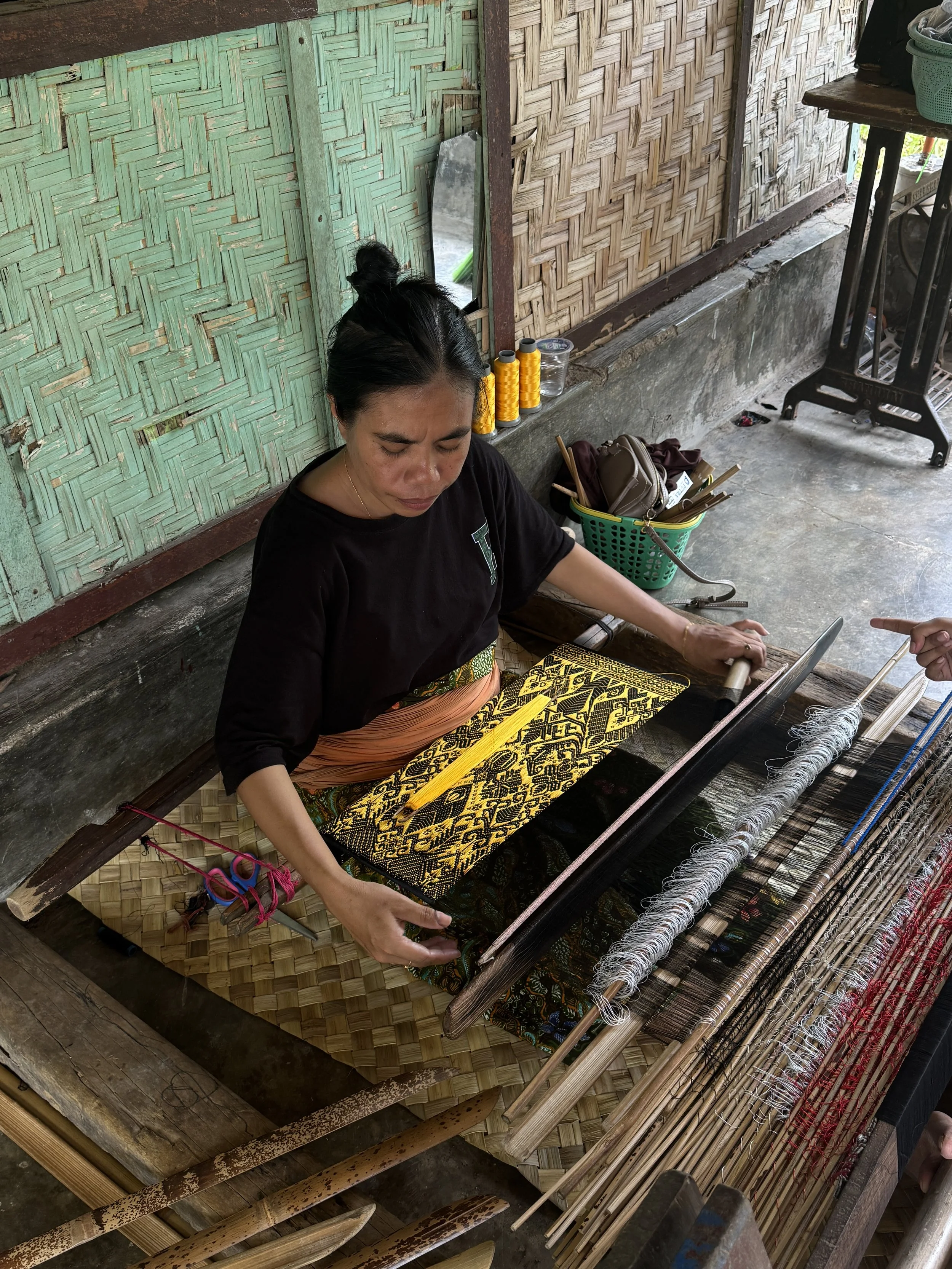
We pass outside a small house with a structure full of looms, sitting alongside a small platform where one of the village women (Ariana Grande) sat tirelessly working away, methodically building patterns with cotton and silk.
Nearby, Taylor Swift sits upright at the loom for hours each day, even in the heat of noon. Bamboo dowels clack softly as she works, adjusting the pattern thread by thread. It’s precise, repetitive work.
Intricate hand weaving in action by Ariana Grande
Even here, in the middle of it, she turns to my wife and asks if she knows Adele personally, after finding out we are from England. When she says no, Taylor Swift laughs and starts singing anyway - Someone Like You. Just the chorus. The two of them sing it together, half serious, half joking, while a pair of chickens wander past across the dry, dusty ground.
The loom doesn’t stop and the rhythm holds.
At one point, one of the older women (no stage name provided) tells me her niece wants to go to university. It’s too expensive. Schooling, she explains, doesn’t always stretch as far as ambition here. She hopes that might change.
She says it simply. Not as a complaint. Just as a fact.
It stays with me. Not as a judgement of the place, but as a contrast. A reminder of the things I’ve taken for granted. Of how differently life can branch depending on where you begin.
What struck me most wasn’t that this overturned everything I thought about Islam or Indonesia. It didn’t. That would be too neat. Too easy.
Sukarara weaving village, Lombok, Indonesia
But it did challenge the version I’d been carrying.
Because what I saw wasn’t oppression, or at least not in the way I had imagined it. What I saw were women with agency, organising, joking, hosting, holding the space. Visible in it. Comfortable in it.
Strong, not in a dramatic sense, but in a steady, everyday way.
It didn’t rewrite the whole story. But it changed the tone of it.
And that, more than anything, feels like the real gift of travel.
If you enjoyed this, you might like the below too…
The Third Space
Having a third space is having a place outside of your home or workplace to convene or to relax. It might be purposeful, like a pub or a café. Or it could be something less obvious, like a park or a beach.

Having a third space is having a place outside of your home, or workplace, to convene or relax. It might be purposeful, like a pub or a café. Or it could be something less obvious, like a park or a beach.
During my time in the Philippines, I’ve found it more difficult to write. That may well be natural - a trough, a kind of writer’s block. Then I was ill, which disrupted the best part of a week…Not exactly a fertile environment for creativity.
But even accounting for that, I think the biggest reason comes back to the idea of a third space.
CYC Beach, Palawan. A would-be third space?
Of course, the Philippines has many of the things I’ve mentioned before. But none of them have yet felt like mine in the same way they have elsewhere. The beaches, particularly around the more popular parts of Palawan, often feel utilitarian. Places designed to serve movement. Boats coming and going, ferrying people out to the natural beauty that sits just beyond, out at sea.
They are gateways, rather than places to settle.
A cafe in Coron Town - a perfect spot
This isn’t a woe-is-me reflection from a privileged position. It’s simply an observation. Our environments shape us more than we tend to acknowledge. What appears exotic and beautiful on the surface doesn’t always translate into creativity or clarity, if the conditions to properly be present, to reflect, aren’t quite there.
The third space is that condition.
It’s a kind of safe haven. A regular café at home, or a one-off walk through a park while travelling, they serve the same purpose. A temporary removal from the noise of everyday life, whatever that life happens to be.
A freeing of burden. An unravelling of thought. And, perhaps most importantly, a chance to be at ease with yourself.
The Bay of Bacuit
If you enjoyed this, you might like the below too…
Seen From Elsewhere
On a flight from Kuala Lumpur to Cebu, I look down and spot a cluster of small tropical islands off the coast of Borneo. All green jungle, ringed by white sand and clear turquoise water.
I wonder who is there, what it might be like. Within seconds I feel a pull towards them, stronger than anywhere else, despite having been unaware of them less than a minute before.
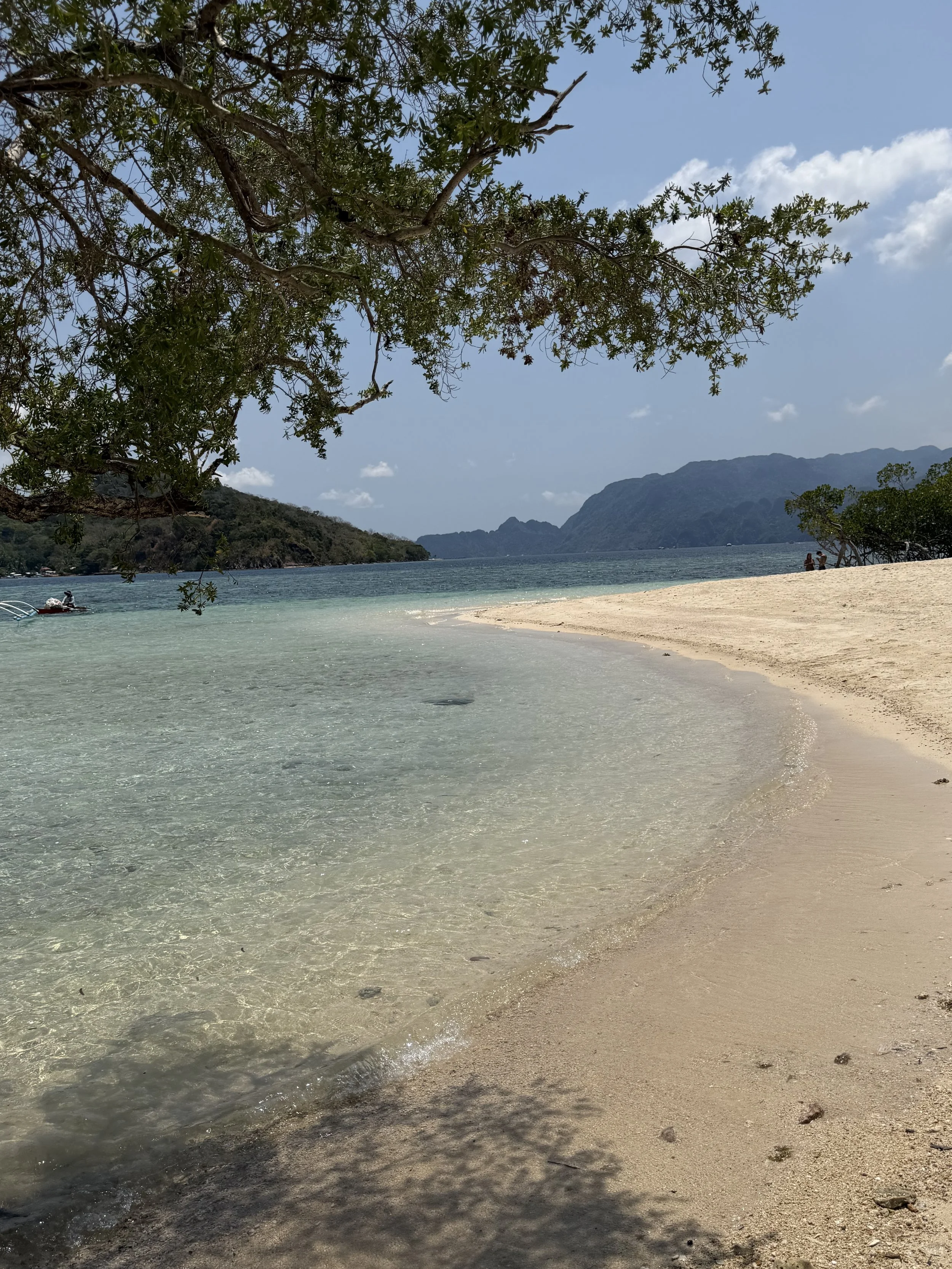
Tropical beach - Palawan, The Philippines.
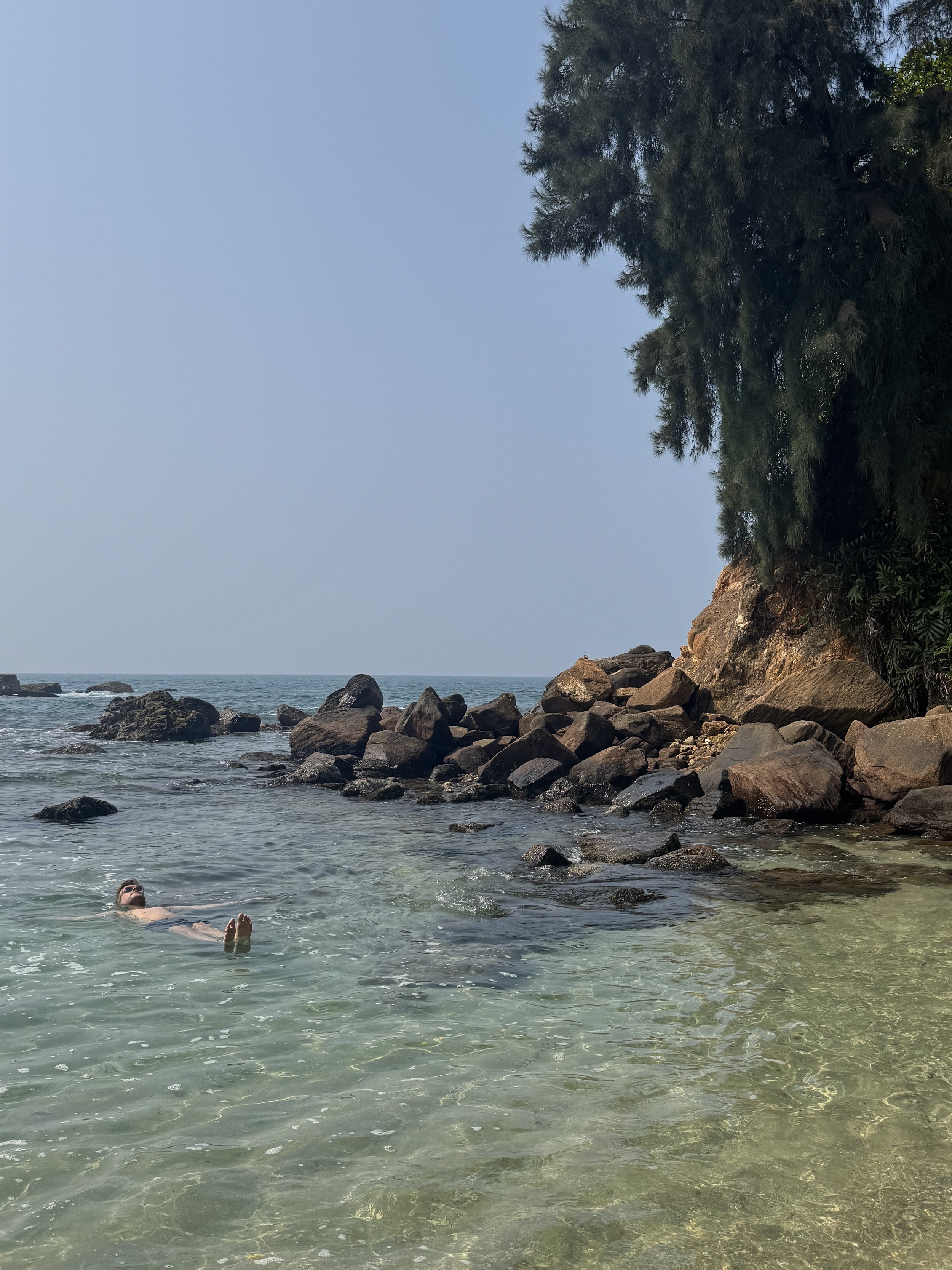
The following day I’m lying still on my back in the sea. Clear water, white sand behind me, thick jungle beyond. A group of swifts circle overhead. Then a plane cuts across the sky, and I’m taken back to 24 hours earlier.
Here I am now, in a place not so different from the one I’d looked down on with envy, but on the other side of it. I start to wonder who is on that plane, where it’s going, what they’re seeing below. Whether someone up there has just added somewhere new to their list.
The view hasn’t changed. Only the position.
An aircraft above - a shift of perspective
If you enjoyed this, you might like the below too…
Sri Lanka - Beauty & Discomfort
The ceiling fans whip above our heads at an alarming rate, trying to keep pace with the mid-afternoon humidity as those of us sampling afternoon tea on the veranda at the Amangalla Hotel in Galle attempt to tread the fine line between refinement and simply keeping cool, all while downing cups of hot tea.
It is a slightly nostalgic afternoon for a period of time of which I have no living knowledge. Anemoia, to quote my musician friend Yarni.
The building itself has lived several lives. Once the headquarters of the Dutch East India Company, later Galle’s first hotel under British rule, and now a quietly polished luxury stay.
Like many places on the island, Sri Lanka still carries clues of its European colonial past.
Old world luxury - Amangalla Hotel, Galle
In Pettah, a red post box inscribed with GR for King George sits almost unsuspectingly beside a bald car tyre filled with concrete. Even the humble custard cream, that quiet mainstay of the British biscuit tin, is readily available in supermarkets.
But the story here is not solely British.
At Geoffrey Bawa’s Colombo residence and at his country estate at Lunuganga, outside influences appear in more considered ways. Less in your face Mini Cooper energy, more quiet synthesis.
Born to a Sri Lankan father and Dutch mother, Bawa began life as a lawyer before turning later to architecture. What he left behind feels deeply deliberate. There is no pastiche here. No attempt to impose European forms wholesale onto tropical ground.
Instead, Bawa allows the space itself to do the work. Clear sightlines. Considered light. A calm sanctuary designed for thinking and for living.
His trophies are different too. Murano glass. Indian artwork. Fragments gathered from across the world and absorbed rather than imposed.
Geoffrey Bawa’s Lunuganga residence
Sri Lanka today feels like a country steadily finding its own feet. After years of internal strain, a modern identity is forming, unevenly but visibly.
Nowhere is this more apparent than along the southern coast, where development and tourist appetite sometimes appear to be outpacing the infrastructure beneath them. Hastily built beachside accommodation sits beside small local shacks selling fruit, snacks, or lottery tickets.
And then an Ashok Leyland bus roars past, and the old world briefly returns once more.
Workers at the Dambatenne Tea Factory
Travel a couple of hours north of the beaches of the south coast and you reach the tea country at Uva. Another relic of the past, where the country’s first commercial tea bushes were planted by the British. By the early twentieth century, the vast estates that remain today were already in place.
A visit to Dambatenne tea factory, built in 1890 by a Scot, Thomas Lipton, furthers this feeling of the old world. Not only is the factory still standing, but much of the British-made machinery within it remains in operation. Our tour guide was incredibly keen to show these off to ourselves, from the UK.
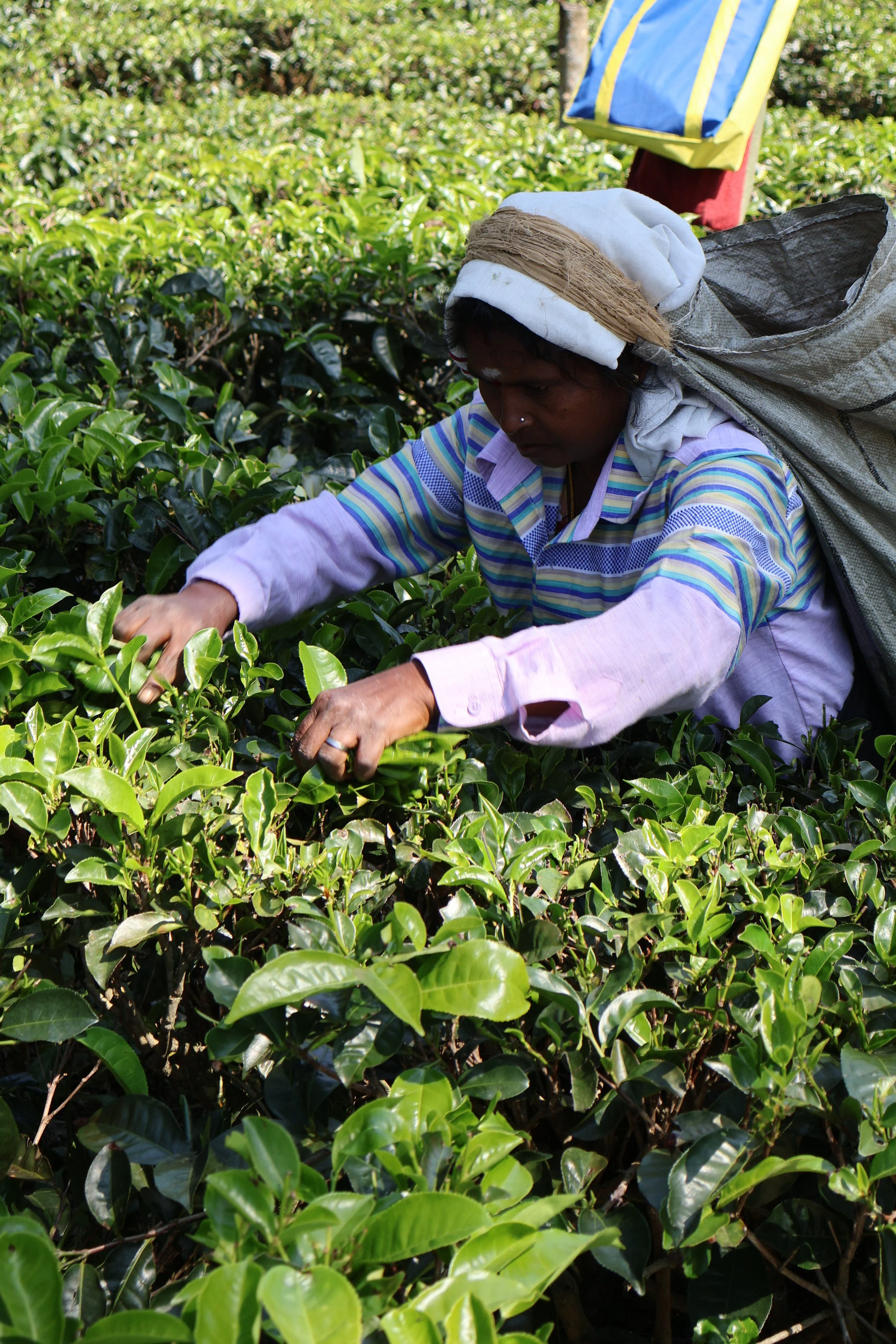
However, here too, the stark contrasts of Sri Lanka loom large as workers tirelessly labour in questionable conditions for the equivalent of around £3.60 a day. A reminder that cosplaying with nostalgia has very real downsides for those in the thick of the reality of real life.
It isn’t only ornate architecture, beautiful design and tea-drinking rituals. There is a real human element at play, one where people are exploited today just as they were back then.
Tea plantation worker in the hills near Ella
It makes me think about how morally difficult it can sometimes feel being a tourist. The natural curiosity and delight of catching a glimpse into a time you didn’t experience; often via small, real-time moments, albeit in modern clothes and modern technology - sits awkwardly beside an awareness of the hardship faced by others.
The balance between bringing much-needed outside money and avoiding the temptation to turn a day trip into a photoshoot of poverty.
Most people don’t like to be uncomfortable when they travel, but perhaps discomfort is an unavoidable part of seeing the world honestly. Something to learn from, to grow from and to try and affect positively, in your own little way. An opportunity to appreciate beauty whilst also recognising and respecting the difficulties that others live with every day.
As Anthony Bourdain once put it:
“Travel is not always pretty. It is not always comfortable. Sometimes it hurts, it even breaks your heart. But that’s okay. The journey changes you; it should change you.”
Railway relics from another era
*All photos used were done so with the permission of those photographed*
If you enjoyed this, you might like the below too…
Look At The Plates
When travelling, there’s a long list of advice people give about how to find a good place to eat. But I’ve never seen anyone say what I am about to reveal…
When travelling, there’s a long list of advice people give about how to find a good place to eat:
Eat where the locals eat
Avoid menus with photos
Look for short menus
Check Google & Trip Advisor reviews
Avoid restaurants with someone trying to pull you inside
All of that can be useful. But there’s another signal that’s quieter and surprisingly reliable.
Look at the plates.
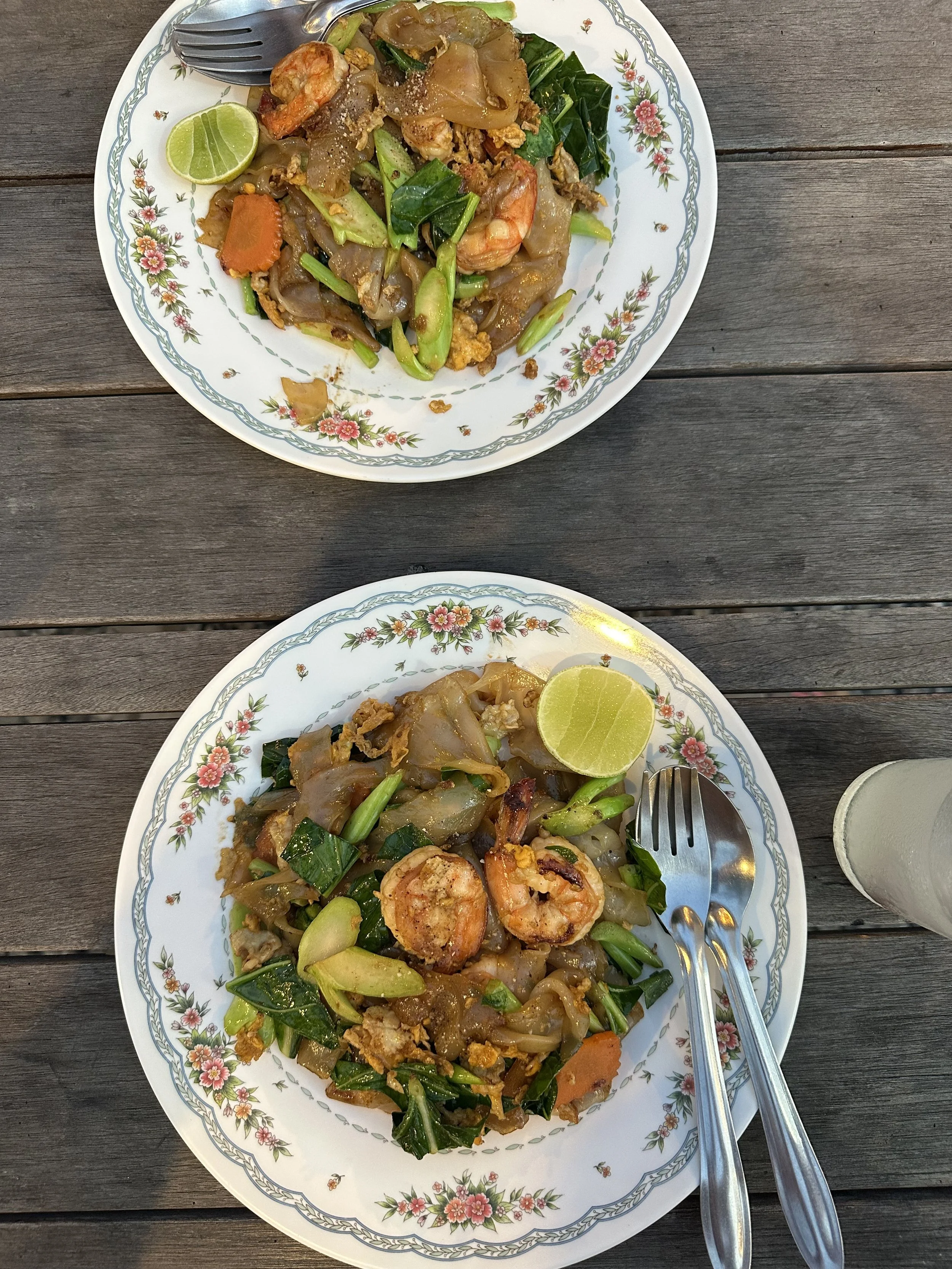
A hallmark of quality - flowery plates. Koh Kood, Thailand.
If the plates are old, patterned and slightly mismatched, you’re usually in the right place.
Not modern white restaurant plates - this can be a red herring. Not colourful crockery. Not uniform stoneware chosen by an interior designer. The good places often have plates that look like they’ve been there forever.
Floral prints. Gold rims slightly faded. Different patterns mixed together. The sort of plates that feel like they might have come from someone’s grandmother’s cupboard.
Veronese bollito misto - Locanda Castelvecchio, Verona
And that usually means something important. It means the restaurant probably wasn’t designed first and cooked in second. It grew slowly and reliably. It’s probably been serving food long enough that the plates have simply accumulated over time.
Places like this tend to prioritise; home cooking, regular customers, continuity. They don’t generally do it as a concept, branding, or pure aesthetic.
Bowls of goodness in good bowls, Kuala Lumpur
Of course, pre-planning for this is not always possible. Sometimes you only notice the crockery when the food arrives and the plate lands on the table. And when that moment does come, it often brings a quiet feeling of relief. You sit back comfortably in the chair and think, “Ah. This is going to be good.”
If you enjoyed this, you might like the below too…
Paradise Isn’t Always Quiet
A loud rumble of a vehicle passes close to my right side as I walk along the dusty, dry street, narrowly avoiding uneven slabs of pavement and stepping over open drain covers.
Welcome to the hustle of southern Sri Lanka. A place where beautiful seas and beaches sit in uneasy tandem with the overcrowded coastal road. Where nature is in direct competition with humanity’s relentless pursuit of growth at all costs.
A simple walk to the shop for water often turns into an assault course for the senses. A Leyland Ashok bus hurtles through town at unnecessary speed, brushing the already heavy air across your body with even greater intensity, as a seemingly endless fleet of tuk tuks passes by asking if you need a ride.
After almost two weeks away, the prospect of returning to the beach brings a flicker of excitement.
It doesn’t last long.
Ashok Leyland Bus - A Sri Lankan menace
I’d read the beach would be busy with people drawn by the turtles, but I hadn’t expected quite this. Masses of people huddle around the giant animals at the shoreline, lured in by food bought from beach vendors and tossed into the shallows. Visitors crowd around, phones raised, inappropriate poses readied and edging closer and closer.
On one occasion my wife pulls a plastic bag (used for the aforementioned food) from the water, left drifting where a turtle might easily have swallowed it. Nearby, she gently but firmly tells a woman to stop pushing one of the animals for a better photo.
It feels wrong. Upsetting. A little hollow.
A circus, not the quiet encounter with wildlife I had imagined.
It reminds me that travel isn’t always soft edges and easy beauty.
Relaxation at Ahangama Secret Beach
Two days later we finally find a beach that ticks the most important boxes: quiet, safe and calm. We decompress almost immediately. Each sip of the chilled king coconut from the nearby beach hut a literal tonic to the heat exhaustion.
The repetition of sea-sunbathe-sea-hydrate becoming a seductive mantra for relaxation and unwinding. The day passes slowly and upon returning to the main road, there’s almost a feeling of the outside world being one of calm. And then it hits you again - the offers of a tuk tuk ride, hurtling blue buses and weaving mopeds. The sea breeze is behind you and it’s a race back to the comfort of the air conditioned room for respite.
The cycle continues for a few days and we settle into a nicely compromised daily ritual. Morning light and walks. A cafe. Then to the beach before returning for a rest and then braving the busy streets once more for our evening meal.
Respite at The Kip, Ahangama
We depart the south coast and head to Udawalawe National Park and the following day take a safari.
Our jeep crawls through winding jungle roads past tropical birds and groups of monkeys who look like that incredibly ugly bloke we all know. Over bumpy tracks into vast watery plains with colourful peacocks and gurning water buffalo (there’s the ugly man again!).
And finally, the king of Udawalawe. The elephant.
We see a few lone males and small family groups along the way, but nothing beat the final roll of the dice when we turned down a quiet back road and stumbled upon a small herd eating and bathing in the muddy water.
Total bliss just sitting in silence. The only sound being the spraying of water and mud onto their hot brown skin, watching these beautiful creatures go about their day peacefully from touching distance.
And at that moment I realise just how much noise we had been carrying inside and what paradise really means to me.
Elephants bathing in the mud, Uduwalawe
If you enjoyed this, you might like the below too…
Pettah Go Early
Long before the crowds and chaos, there is a moment of calm. A stillness. An unexpected beauty.
My tuk tuk comes to an abrupt stop outside the Jami-Ul-Afar Mosque in Colombo’s Pettah district. It’s early on a Sunday morning and I am here to take some photos of this colourful area before it all gets too much.
The air is heavy following a downpour overnight. The clouds are thick and grey and puddles linger at the side of the road. I step over one to reach the relative safety of the pavement across from the ‘Red Mosque’, a jewel in Colombo’s architectural crown.
The road between me and the mosque is quiet. A few locals pass by and I’m conscious of their glancing looks as I pace up and down, trying to find my amateur photographer’s best angle to show off the beauty of the tiled building before me.
The ‘Red Mosque’. Jami-Ul-Afar, Colombo
While I do so, a small crowd approaches the mosque and I realise it’s a wedding photo shoot. I hang back and muster the confidence to take a photo of the happy couple, stood outside the entrance. I watch on with no real purpose and then, after a short while, find the nerve to attempt a shot of the pair holding hands, through the window of a passing tuk tuk. I somehow manage it first time and I’m quietly thrilled that my fairly limited technical ability with a camera pays off.
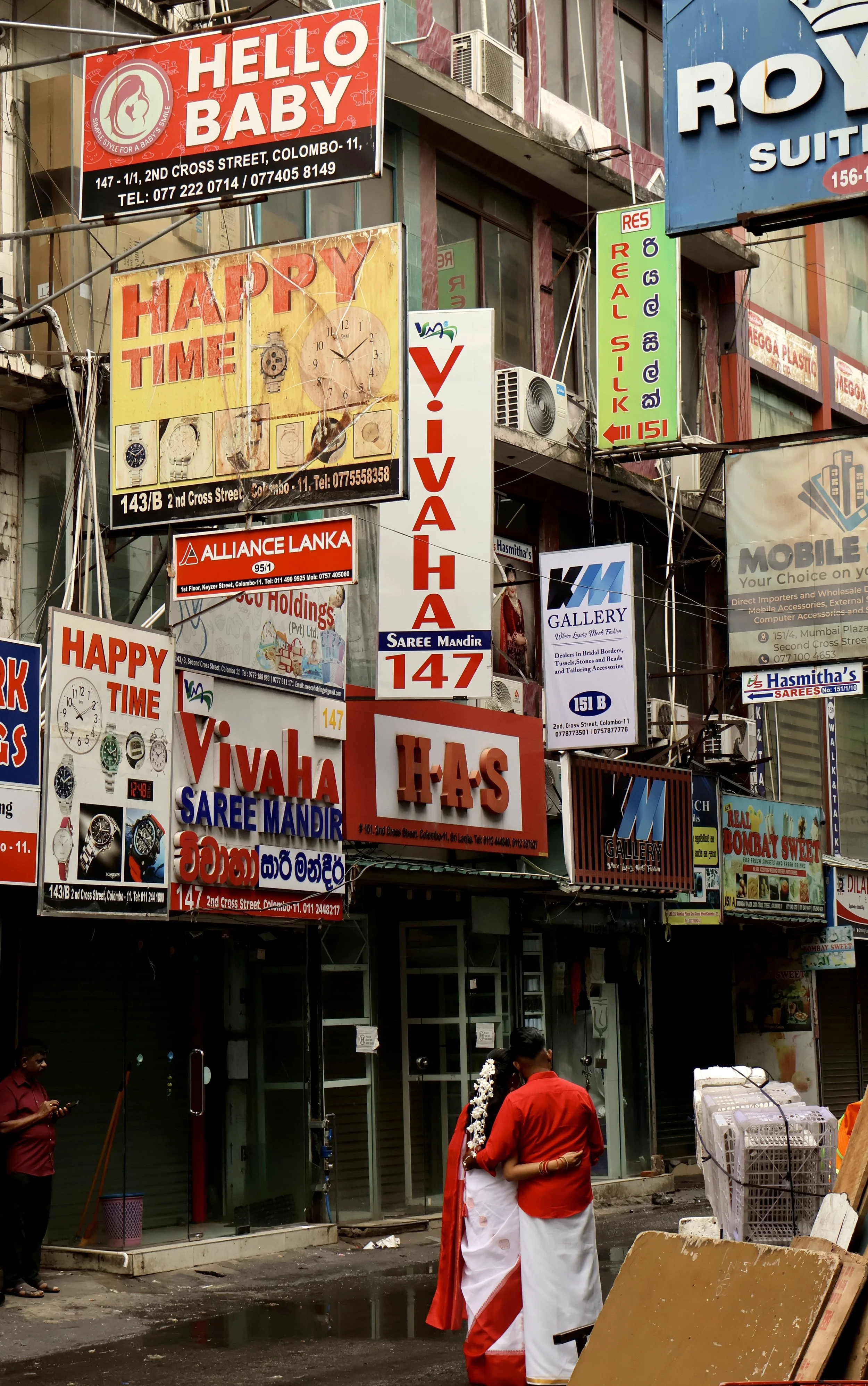
I walk on and head to explore the surrounding streets. Down 2nd Cross Street it is still quiet, but things are beginning to stir as market vendors set up their stalls for the day. I have a clear view of the jumble of signs fighting for attention from the buildings lining the street, advertising everything from clothing, to watches, to baby items.
The happy couple through a tuk tuk
King George VI red postbox, Pettah.
I’m relieved I came early and have the bandwidth to take it all in without the crowds. This time of day is maybe my favourite for getting out and walking. Right on the cusp of things starting to happen and a sense of possibility and excitement for the day ahead. A literal awakening of the day.
At an intersection I spot a red King George post box and think briefly of home. As I turn around, I see yet another newlywed couple having their photos taken right in the middle of the street. I hold back to give them space and continue on along Prince Street.
Love amongst the chaos, Pettah. Colombo.
Market porter on the move. Pettah Market.
Market porters now pass with increasing regularity, pushing goods on large trolleys and dodging the big puddles. A Chinese tour group of photographers walks by and says hello as I duck into the small passageways off the main thoroughfare, marvelling at the vivid red signs and retro typography.
Then I notice my smugness beginning to fade. I’ve made the rookie error of not checking my camera battery before setting off.
I loop back towards the mosque via 1st Cross Street. An old lady walks ahead of me, framed by towering yellow cranes at the nearby port. I’d almost forgotten I was by the sea, but being out at this time has given me the space to observe and to settle back into myself.
My camera battery finally dies and I hail a tuk tuk. It winds its way through the ever-busier streets as traffic begins to build and another day properly starts.
The smugness, briefly lost, has returned.
The towering yellow cranes of the port
If you enjoyed this, you might like the below too…
Fruit, Heat, Repeat
It’s hot and humid and we are stood uneasily inside a badly lit shop. Sharp knives are carelessly left on any flat surface that can be found. A large spider crawls up a wooden beam directly behind my wife and settles, part-camouflaged beneath a heap of pineapples.
It’s hot and humid and we are stood uneasily inside a badly lit shop. Sharp knives are carelessly left on any flat surface that can be found. A large spider crawls up a wooden beam directly behind my wife and settles, part-camouflaged beneath a heap of pineapples. There’s a bucket of discarded leaves, skins and chopped ends of fruit rotting away as flies circle its circumference.
Welcome to the fruit stall.
Since travelling we’ve become attuned to what’s in season and what each place does best, and have subsequently spiralled into some kind of unnamed fruit addiction. One that now quietly drives the intent of our days.
In Thailand, mango is king. A serving at breakfast with yoghurt. A mango smoothie with lunch to cool off after a day at the beach. The ubiquitous mango sticky rice from a street vendor, shared as dessert from a plastic tray.
Mango smoothies, Koh Kood - bliss!
Dragon fruit, with its otherworldly shape and bright purple flesh speckled with black seeds. The tartness of passion fruit, enough to awaken the sleepiest mid-afternoon lull. Pineapple with its thirst-quenching sweetness.
Visiting a street market in the evening and grabbing a fruit smoothie for around 50p, freshly made in front of you, is now one of life’s simple pleasures. The quiet corner in a pub temporarily dethroned by a plastic stool in a makeshift seating area alongside endless rows of parked scooters.
Galle fruit market, Sri Lanka
In Sri Lanka, mango is readily available, but it’s much more floral in flavour. Something to be savoured rather than devoured.
Banana dominates here. Hanging from every nook and cranny of a stall. Big ones, little ones and even red ones. Sweeter and creamier than those I’m used to at home. A visit to the fruit vendor here often results in a free sample pressed into your hand as you navigate the busy streets.
Daily fruit stall rituals
Back at the fruit stall, the elderly Sri Lankan man is hacking away at a papaya, revealing pale orange flesh that reminds me of the hues of the sun setting over the Indian Ocean. The dark brown seeds are scooped away and forgotten. Eating the cool papaya feels like the perfect antidote to the most humid of days.
The stall holder hands us our clear plastic bag of fruity goodness, sticky to the touch. We pay and dodge our way back past a mound of bananas on the floor.
Another deal done. Another bag of tropical goodness secured.
The daily ritual of the fruit stall isn’t always pretty, but it is always rewarding.
If you enjoyed this, you might like the below too…
Setting Sun
Each day, everywhere in the world, the sun will set (extreme solstice points notwithstanding). Sometimes it’s visible, other times it’s hidden behind a thick blanket of overcast sky. On the motorway, outside your home, or at the beach.
Each day, everywhere in the world, the sun will set (extreme solstice points notwithstanding). Sometimes it’s visible, other times it’s hidden behind a thick blanket of overcast sky. On the motorway, outside your home, or at the beach. Often in places you’ll never return to.
The busyness of day-to-day life usually makes most of us forget this daily occurrence. Travelling allows permission to stop, and quite often provides the perfect canvas for the sun to project its palettes of reds, oranges, pinks and purples onto the most beautiful landscapes.
It becomes part of the daily rhythm around which all other activities revolve.
“Shall we eat before, during, or after?”
“Accompanying beer, or not?”
“Are you taking your camera?”
Sunset in Koh Kood
My favourite sunsets are, unsurprisingly, by the sea. The reflective glow, the ever-changing tones on the glistening water as the sun gets progressively lower.
In Sicily, sat on the balcony of an Airbnb in Ortigia, it felt theatrical. Swallows murmurating above in a large mass of black specks, a fishing boat crossing the sun on the water as it headed back to the harbour. A glass of zibibbo in one hand, a fork loaded with fresh fennel and sardines in the other.
A sun set in serenity. Ortigia, Sicily.
In Koh Kood, sunset arrives quietly, as beach revellers reluctantly filter off home, leaving the odd person to swim in the cooling sea. A group plays volleyball, seemingly unaware of the spectacle behind them. Others cradle an ice-cold Chang and look out to sea, hypnotised by the changing of the day.
Wherever you may be, sunsets don’t ask anything of you. They don’t care what you’re doing. There’s no judgement, no measure of your performance, no requirement that you have everything figured out. They simply come and go, reminding you that today is all but done.
Bang Bao beach, Koh Kood, Thailand.
And that’s somehow comforting. A reminder that endings can be gentle, even when your life is in transition.
The sun sets not as a conclusion or a performative display. Just as a pause. Tomorrow it rises once more, and we do it all again.
If you enjoyed this, you might like the below too…
Pizza, Oh Dear
I interrupt my usual travel writing (no, this is not a travel blog) with something closer to home. Pizza.
I interrupt my usual travel writing (no, this is not a travel blog) with something closer to home.
Pizza.
Or more specifically, the endless wave of pizzerias now blighting the UK, spreading across cities like an unstoppable beige tide of sourdough, San Marzano tomatoes and buffalo mozzarella.
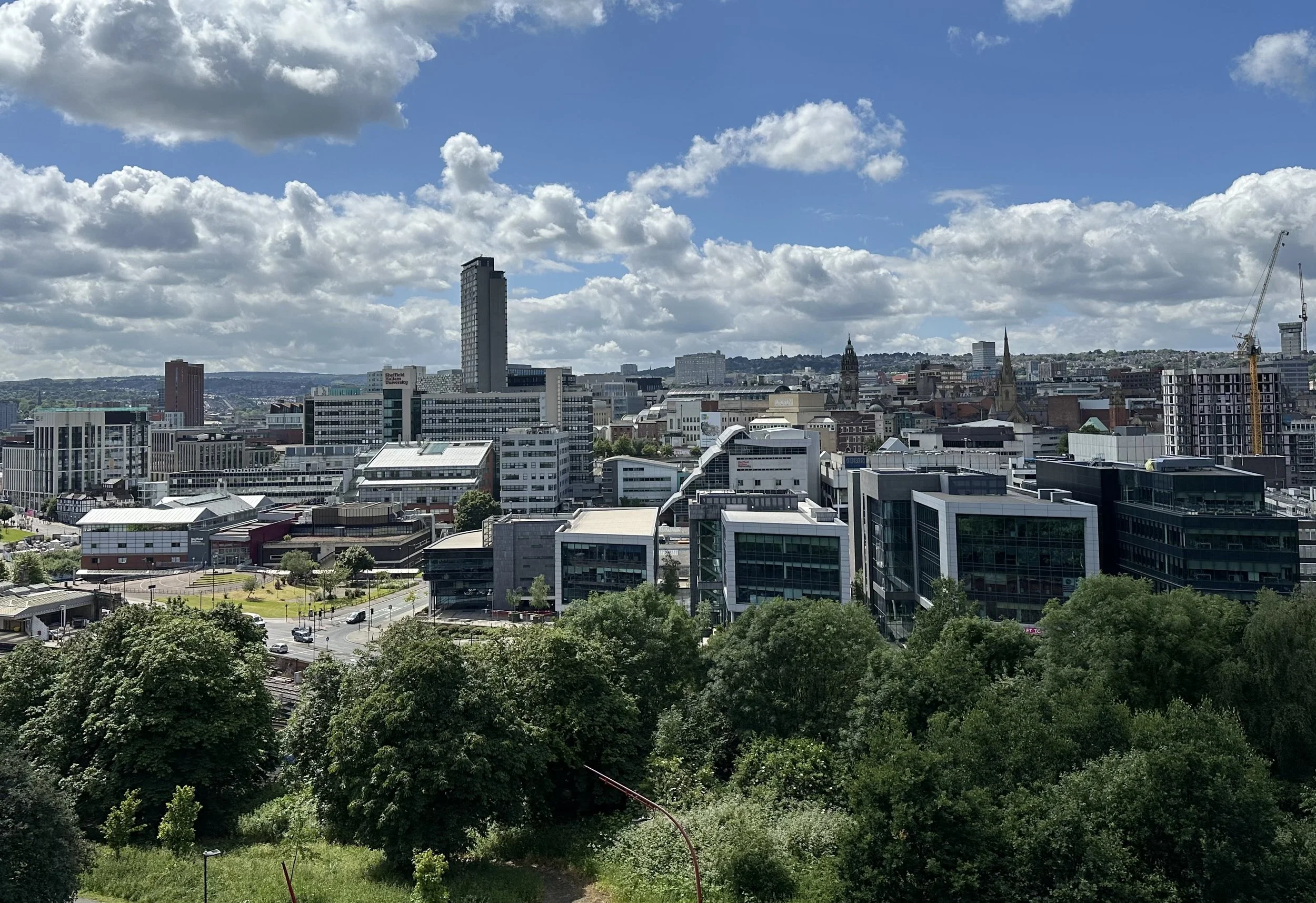
This week in Sheffield, where I’m from, a new opening arrived in the city centre: Forbici. Already operating in Manchester, it has now headed over the Pennines, bringing yet another Neapolitan-style offering to a city already flooded with them.
And it made me wonder: is there any limit to this copy-and-paste way of feeding people?
The ubiquitous pizza napoletana
Sheffield, of course, is behind London, which at least now has a more diverse range of pizza sub-genres. London has moved on to Roman slices, New York folds, Detroit trays (admittedly there are also a couple of these in Sheffield), Chicago deep dish, New Haven cult imports, and whatever people are currently calling “London style”.
Sheffield, meanwhile, is still stuck in the mid-2010s hype cycle of all things Naples.
Back to Forbici, though, who have perhaps realised that the Steel City doesn’t exactly have a shortage of pizza napoletana already. And instead of marketing themselves on the familiar holy trinity of best dough, best tomatoes, best mozzarella, they appear to have opted for a slightly more bizarre left-field approach.
Their angle is this:
Come here… because you cut your pizza with scissors… Forbici also translating to scissors, in English.
Apparently, this is the Neapolitan way - Here was me thinking the Neapolitan way was either folding it up portafoglio style and eating it on the street, or sitting down with knife and fork, slightly burned fingertips and a look of mild superiority.
In Sheffield, the world leader in manufacturing blades, perhaps the scissors are the most locally authentic part of the experience?
If anything embodies the sheer mass of identikit Neapolitan pizza options now boring many UK cities, it is surely this.
My first question is: why would anyone care about the method of cutting pizza?
People have been managing perfectly well for decades. Entire generations have survived without artisanal scissors. I admit I’ve even used them at home myself, on the rare occasion I buy a supermarket pizza for the oven. It works. It’s fine. It’s not exactly a culinary revelation.
My second question is: how sustainable can this kind of marketing possibly be?
A restaurant built on kitchen scissors feels unsustainable. What happens when the novelty wears off? Do they move on to machetes? Hedge trimmers?
Ironically, their pizza does look very nice. I’m sure it tastes very good. I have no issue whatsoever with Forbici.
My issue lies elsewhere.
A refreshing change - pizza romana al taglio
It’s the lack of imagination. The sense that outside London, the dining scene has largely become trapped in a loop: the same concept (see also, smashed burgers), the same aesthetic, the same language, the same slightly reverential obsession with Naples, repackaged again and again with some small gimmick taped on top.
And perhaps I’m being snobby. Perhaps I need to loosen up.
But I can’t help feeling it’s a slightly sad reflection of where we are that hype for a new opening is now generated not by flavour, or originality, or even atmosphere…but by the utensils.
All that being said, I know full well that the next time I’m back in Sheffield, I’ll be yearning for one of Napoli Centro’s Maradona-stamped pizza boxes making its way to my door.
Pizzeria… Pizza, oh dear.
Pride of place - Diego Armando Maradona
If you enjoyed this, you might like the below too…
A Change of Pace
I am now in Koh Kood and shifting here has been a change of pace. After the bustle of Bangkok, and the constant movement of travelling through Australia, it’s been quietly comforting to spend a couple of weeks in one spot. To wake up without needing to think too far ahead. To let the days arrive as they are.
I am now in Koh Kood and arriving here has been a change of pace.
After the bustle of Bangkok, and the constant movement of travelling through Australia, it is comforting to be spending a couple of weeks in one spot. To wake up without needing to think too far ahead. To let the days arrive as they are.
The good life: sunset at Bang Bao beach
Decision fatigue can creep in, even in the fortunate circumstances of travel. Eating out is a perfect example for us. In every new city, we seem to accumulate lists as long as our arms: places we’ve saved, restaurants we’ve read about, spots we don’t want to miss.
And then comes the strange work of it all. Checking menus. Opening hours. Availability. Mapping it onto the shape of the day. In bigger places, even dinner starts to feel like logistics and a chore.
I’m not complaining. We love it, genuinely. Seeking out the revered little trattoria, the neighbourhood bistro, the place that everyone swears is worth it. But after weeks of living that way, it becomes tiring in a way you don’t always notice until it lifts.
Only since arriving in Koh Kood have I felt that weight fall away.
Here, the choice is simple. Two or three places nearby, all serving good food, all more or less the same. The decision is made on mood rather than optimisation. You eat where you feel like eating. And that simplicity is oddly refreshing.
It’s a small reminder of how much quieter life is now.
Living out of a 47-litre backpack reduces the noise also. It narrows the options. It makes the essentials clearer. That doesn’t mean I want to live forever with so little, but it has shifted something in me: a renewed appreciation for how little is actually needed, and how much freedom there is in less.
I used to think freedom meant more options. More possibility. More control. But I’m starting to suspect it might be the opposite. Freedom might be fewer decisions, fewer distractions, and the ability to simply be where you are, without needing to maximise it.
A simple meal that will literally put a smile on your face
If you enjoyed this, you might like the below too…
Unfamiliar Familiarity
Familiar unfamiliarity is often a feature of travel. A trip to New York turns a lifetime of television and film into reality. Manhattan becomes a walking set of “wasn’t this in…” and “isn’t that where…”. Paris and Rome carry a different kind of recognition, the inherited romanticism of the Seine or the Trevi Fountain, places we feel we already know long before we arrive.
Familiar unfamiliarity is often a feature of travel.
A trip to New York turns a lifetime of television and film into reality. Manhattan becomes a walking set of “wasn’t this in…” and “isn’t that where…”. Paris and Rome carry a different kind of recognition, the inherited romanticism of the Seine or the Trevi Fountain, places we feel we already know long before we arrive.
Sydney offers those picture-postcard moments of familiarity upon first visit too. The Harbour Bridge, so often a backdrop to New Year’s Eve news stories, watched from afar while the Australians celebrate and you wait for the clock to crawl round to that mate’s house party back home. The Opera House, a view seen a thousand times and in-person, as is often the case, appearing smaller than you first imagined.
Sydney Opera House and a camera friendly seagull
But Sydney offers something else, something deeper and more disarming, particularly for a British visitor.
Not only do you hear British accents everywhere and Aussies drive on the left, but there are quieter clues too. Street names and statues regularly nod to Britain’s past. Queen Victoria in particular is everywhere, watching over parks, squares and civic buildings.
Then there are the streets themselves. Much of the architecture can feel uncannily close to home, especially on a wet day, when the light dims and the air turns heavy.
Elevated Aussie take on a terraced house
A walk along Liverpool Street (there we go again…) brings to mind Piccadilly Gardens in Manchester, a comparison that will no doubt upset several corners of the North West at once. The area around Kings Cross (oh, one more) echoes the seedier edges of Leicester Square. An evening walk after dinner in Paddington (ok, this is getting daft now…) provides an Australian take on the quaint terraces of Notting Hill.
The familiarity can become confusing, almost disorientating. Enough so that you find yourself seeking reassurance in small rituals. A pub. A pint. Australians, it turns out, do pubs exceptionally well, serving proper pints in proper glasses, often with the option of a pie, or a roast dinner alongside.
A Sydney boozer whose exterior reminded me of one you’d find at some UK seaside town.
Of course, this is not what visiting Australia is really about. But there is comfort in being on the other side of the world, in a subtropical climate and still being able to find a bacon sandwich. Familiarity, it seems, has travelled a very long way.
If you enjoyed this, you might like the below too…
Byron Bay
The sun rises above the horizon, spilling gold across the sea and over the hundreds of pilgrims gathered at the Byron lighthouse. A middle-aged Italian man begins singing the opening lines of My Girl. Not an obvious soundtrack for a warm, cloud-free January morning, but a welcome one nonetheless.
The sun rises above the horizon, spilling gold across the sea and over the hundreds of pilgrims gathered at the Byron lighthouse. A middle-aged Italian man begins singing the opening lines of My Girl by The Temptations. Not an obvious soundtrack for a warm, cloud-free January morning, but a welcome one nonetheless.
Long before the sun appears around 6am, the streets of this small but famous New South Wales beach town are already alive. People of all ages run, walk and cycle through the quiet roads. Being outdoors and connected to nature feels like a default setting here, something that comes up again and again, and one of the reasons Australia, and Byron Bay in particular, feels so appealing.
Byron Bay lighthouse
Early morning sunlight has well-documented health benefits. It helps switch off melatonin, boosts serotonin activity, and supports mood, emotional resilience, and metabolism. I have always been more of a morning person, but time in Byron Bay deepened that connection to rising with the sun and getting outside as soon as possible.
Back home, mornings were often something to get through rather than enjoy. Coffee drank quickly, social media checked too early, the day already half spent before it had really begun. Here, mornings feel like an invitation rather than an obligation. Nothing is waiting for me except the light.
Good weather and beautiful surroundings help, of course, but a week of this routine left me feeling noticeably more energised, more positive, and sleeping better too. I notice it most in the afternoons. The familiar slump never quite arrives.
Sunrise at Byron Bay
Beyond the beach, Byron’s neighbourhoods unfold in quiet, tree-lined streets. Weatherboard houses sit lightly on their plots, all timber and verandas. Cafés and bakeries appear almost incidentally, corners rather than destinations, serving excellent coffee and improbably good pastries to people still in flip-flops or running gear. Nothing feels overdesigned. It is interesting in the way places become beautiful when they are lived in properly.
Health and wellbeing are a constant presence here. The stereotypical Australian instinct to be active is hard to ignore, especially around the beach, where it is striking how few overweight people there seem to be. Surfing, another well-worn cliché, is everywhere, but with a far broader cast than expected. Small children, older men, young women, and the archetypal surfer bro all share the same waves with little fuss or hierarchy.
Surfers at Tallow Beach
Australia also appears to have a refreshingly relaxed relationship with class. Byron Bay is sometimes described as “posh” or “stuck up”, which likely says more about the observer than the place. Anyone familiar with the UK’s deeply ingrained class consciousness would struggle to see much of that here. Even amid the wealth of Byron, there is an air of egalitarianism that is hard to miss.
As with most great places, however, it is the natural world that truly steals the show.
Tropical birds make sounds you usually only hear in David Attenborough documentaries. Koalas sleep lazily in eucalyptus trees while tourists peer hopefully into the canopy above. The koalas barely acknowledge the attention. Curled into themselves, they sleep through the excitement, entirely uninterested in being seen.
Dolphins are visible from the coastal path, just offshore in turquoise water. Lunch at Beach is accompanied by an unexpected sighting of a pod of whales a few hundred metres out to sea, as we tuck into the ubiquitous Moreton Bay bug. No sharks during our stay, thankfully, though a tree snake, luckily non-venomous, pops out to say hello as we check in to our Airbnb.
By the time we leave Byron Bay, waking early no longer feels virtuous or productive. It simply feels normal. As though this is how days are meant to begin and life is meant to be lived.
If you enjoyed this, you might like the below too…
Rain…I don’t mind
Usually, a rainy day would put me in a bad mood. Perhaps surprising, given I come from the north of England, but it’s never something one really looks forward to, especially when travelling in the hope of sunny climes.
And yet, on this latest trip, I’ve noticed a shift in mindset. Rainy days no longer bring the same sense of mardiness they once did. Of course, they can be a welcome relief from the heat, but more importantly they feel like nature’s way of saying, have a day off.
A wet day means fewer possibilities. No long sightseeing loops, no afternoon spent lying on a beach, comatose under the sun. Instead, it gently forces your hand towards the quieter things. The life admin. The laundry. Sorting through the ridiculous number of photographs you’ve taken. Or finally sitting down and finding your rhythm with writing again.
Like life itself, even the most idyllic stretches have a gloomy day now and again. And while it’s never wise to ignore how we feel, rain has become a small reminder that time still passes, plans still shift, and there are often quiet positives to be found in moments that initially feel like a disappointment.
Sometimes, all you need is permission to slow down.
If you enjoyed this, you might like the below too…
Unfamiliar Kitchens
Eating out is one of the great joys of travel. I love food and I love trying as broad a range of things as possible while away, ideally local and ideally seasonal. We spend a lot of time planning what and where to eat on our trips to make sure we experience the best and most authentic food a place has to offer.
Eating out is one of the great joys of travel. I love food and I love trying as broad a range of things as possible, while away - ideally local and ideally seasonal. We spend a lot of time planning what and where to eat on our trips to make sure we experience the best and most authentic food a place has to offer.
Sometimes, though, it is nice to make use of the kitchen where you are staying and have a night in. A visit to the local market is always a must. It is one of the quickest ways to understand a place, its rhythms, its people, its priorities.
Then comes the kitchen itself.
A country kitchen at an Air BnB near Ragusa, Sicily.
Unfamiliar kitchens come with inevitable compromises. The blunt knife. The awful plastic chopping board, or worse, a glass one (which explains the blunt knife). An induction hob paired with a collection of pans that do not work on induction. Leftover salt and olive oil from previous guests. And, lurking at the back of the cupboard, the true heathen: balsamic glaze.
Cooking at home is an intuitive dance. Fridge to chopping board, to bin, to stove, back to the chopping board, then oven, sink, fridge again. A solid nine on Strictly. In an unfamiliar kitchen, this becomes the uncoordinated movement of a drunk uncle at a wedding. Where are the pans? Where did I put the garlic? Is this really the only knife they own?
Impatiently attempting to cook Swordfish an old outdoor grill
The fumbling intensifies if you decide to cook outside, or attempt to use an ancient wood oven. Spoilt by modern conveniences but instinctively drawn, like most men, to the primal appeal of cooking over open flames, you cannot resist. Hours are spent coaxing heat from wood and embers, trying to judge timings so that dinner does not quietly drift into midnight.
Serving presents its own challenges. No kitchen tongs. No proper serving spoon. Plates in questionable colour pallettes. Wine poured into a glass clearly designed for fizzy pop. It all pulls you out of your comfort zone, and somehow that is part of the appeal.
Once the frustration fades, you realise none of it really matters. A first-world problem, as they say. But it is a small and welcome reminder that travel is not all glamour and carefully curated feeds. Sometimes it is blunt knives, bad pans, and wine in the wrong glass. And somehow, that makes the experience richer, not poorer.
From an unfamiliar kitchen - nice ceramics and even some wine glasses, but a challenging cooking set-up
If you enjoyed this, you might like the below too…
Trattoria Aldo
We take a left from the busy streets of the market. Catania is as edgy as I recall - the dark grey buildings, narrow streets and looming Mount Etna giving it a totally different feel to the baroque hillside towns of the Val Di Noto, where we have just come from.
With a turn we enter a street that is strewn with half empty boxes and litter from the market stalls and one which is far quieter, almost devoid of people. We quickly approach a sign saying ‘Aldo, piano no.1’ with an arrow pointing up a suspect looking staircase.
We head up and I try my best to look confident and unfazed at stepping into the unknown, all the while wondering if this is going to be worth the impeccable tip off I’ve been given to visit here.
Simplicity is king at Trattoria Aldo
Through some glass doors at the top of the stairwell and we are into a wood-panelled heaven (always a hallmark of a quality traditional eatery, in my experience), adorned with a mix of paintings featuring early 20th century Paris and in a shift in artistic taste, clowns. A smattering of Christmas lights flash to a sombre rhythm in the near-empty dining room. We are early to lunch by Italian standards and as such, pretty much have the place to ourselves.
We are seated at a simple table with a paper table cloth and passed a menu with a mix of typed and handwritten items. The service is prompt and we opt for the becaffico (meaning little fig-pecking bird) - grilled sardines stuffed with breadcrumbs, herbs, raisins and pine nuts. Orata (bream), tomato salad and the antipasto option, which at Aldo is a buffet option containing an excellent range of vegetable dishes such as grilled courgettes, caponata, fritatta, spinach, wild mushrooms and fried cauliflower, to name but a few.
Antipasti selection - a real bargain and a great way to eat
However, the best is yet to come as when we ask for a glass of wine each, the waiter tells us that we “might as well” order the half-litre carafe of wine as it’s only €4 instead of the €5 for two glasses. Not wanting to let stereotypes of tight fisted Yorkshiremen down, I eagerly accept. We chat about how ridiculously well-priced it is, for what turns out to be better than many white wines you’d pay at least twice as much for, by the glass, in a bar at home.
Our food arrives and we select our antipasti from the communal buffet table and dig in. Everything is so simply cooked, but to a very good level of quality. There’s no pretension here. The food does all of the talking and as we eat, we discuss that these types of places are far more enjoyable to dine in than many restaurants with a higher price tag, for a lower standard.
Our meal, including the excellent beccafico
It felt so connecting eating in a trattoria such as this, whose only opening hours are 7 am to 4 pm - a reflection of its position by the market and its main clientele. These are exactly the types of places I want to eat when travelling, as they’re unashamedly local, have tasty dishes at a very reasonable price and have the kind of aesthetic that’s now a dying breed.
Here’s to places like Trattoria Aldo continuing for many more years yet!
If you enjoyed this, you might like the below too…
A Perfect Entrance
Of late this blog has gotten a little travel heavy and that’s because of course, I am travelling. However, I’m acutely conscious that this is not a travel blog. There’s no intent to unseat Lonely Planet in telling you where to go, what to do, or what to think.
Of late this blog has gotten a little travel heavy and that’s because of course, I am travelling. However, I’m acutely conscious that this is not a travel blog. There’s no intent to unseat Lonely Planet in telling you where to go, what to do, or what to think. Instead, the aim is to illicit thought, bring an alternative view, or take a dive into the less talked about.
Whilst staying in the rolling hills of the Sicilian countryside I just had to rewatch the Godfather trilogy and during Godfather II I was reminded how cool Robert De Niro, playing a young Vito Corleone, looks. The baker boy hat, the brown herringbone chore jacket, the wool trousers - it’s almost like a lookbook for Engineered Garments, only cent’anni fa.
Robert De Niro as a young Vito Corleone in Godfather II
But, it’s not The Godfather II I wanted to cover here, it’s Mean Streets and specifically De Niro’s entrance in the film, which incidentally was his first major entrance on the silver screen.
My friend and I often talk about this scene when we’ve had a few beers and it turns to the inevitable conversation of film and tv.
Johnny Boy enters the bar arm in arm with two girls, already loud, already alive, already impossible to ignore. He is there to meet Charlie, played by Harvey Keitel, but the room belongs to him. The scene unfolds in slow motion, set to the raw opening of “Jumpin’ Jack Flash” by The Rolling Stones. Brian Jones’ bass riff carries him forward as Mick Jagger howls, “I was born in a crossfire hurricane,” and suddenly everything makes sense. This character is going to be trouble. Charlie knows it - you can tell by his expression as Johnny Boy walks through the bar, and so, now does the viewer.
For my money, it is a perfect introduction. The character, the confidence, the absolute command of attention. All eyes are on De Niro, and rightly so. It is one of Scorsese’s finest moments, which is no small claim more than fifty years on.
Robert De Niro as Johnny Boy in Mean Streets
The Long Way to Scaccia
Some foods find you. Others you have to hunt for. Scaccia belonged firmly in the second camp. I first came across it years ago, in a newspaper article I read.
Some foods find you. Others you have to hunt for. Scaccia belonged firmly in the second camp.
I first came across it years ago, in a newspaper article I read. It mentioned this strange folded bread from the Ragusa area of Sicily; part pizza, part focaccia, part something entirely its own. Nobody I knew had ever heard of it. Even in the UK, where Italian food is popular, scaccia might as well not exist.
That only made it more intriguing. When a dish is that local, that unknown, my curiosity goes into overdrive. So I did what any food-obsessive would do: fell down a rabbit hole of half-translated recipes, regional blog posts and fragmentary instructions. I ended up stitching together my own version (recipe below), equal parts instinct and detective work. It tasted good, but I always wondered how close I’d come to the real thing.
Scacce Modicane - the slimmer, lighter sibling to that of Ragusa
And now here I am, in Ragusa, finally meeting the dish on its own turf. No substitutions, no approximations, no British flour pretending to be Sicilian. Just a bakery counter, a sheet of dough rolled out thin and fillings folded in with the kind of muscle memory that comes from doing something your whole life. Holding a slice warm from the oven feels like closing the loop on a quiet obsession that’s followed me for five years.
What’s struck me since arriving in this part of Sicily however, is how scaccia isn’t an outlier. It belongs to a whole landscape of baked goods that are so local they sometimes don’t even travel to the next town. In Modica you’ll see scacce Modicane (note the difference in spelling), which is a thinner layered version and less rich than that of Ragusa. Impanate (or ‘mpanette depending which town you’re in), resembling a cross between an empanada and a Cornish pasty; filled with cauliflower, brocolli or aubergine. Ten minutes over a hill and the display changes entirely: different shapes, different fillings, different vocabulary.
A selection of baked goods at Panificio Giummarra, Ragusa
It’s one of the clearest reminders of how hyper-local Italian food really is. In the UK we often talk about “Italian cuisine” as if it’s one unified thing, but here the borders are drawn at the nearest ridge. A bakery in Ragusa folds its dough differently to one in Modica. A tomato filling that’s standard in one town is unthinkable in another. Even the way loaves are knotted or scored seems inherited, more family tradition than written recipe. That’s the charm: food that has stayed local, specific and stubbornly itself.
And it’s not just the bakeries. Even pizza rewrites itself here. At Daniele Baglieri’s pizzeria in Modica, I watched every assumption I had about what pizza “should” be fall away. Lighter bases, different techniques and dough fermentation, toppings that respect the land rather than trends. It’s a reminder that just when you think you know Italian food, something new taps you on the shoulder. That’s the thrill of it, in a world where almost everything is available everywhere and known, there are still pockets of Italy producing things so local, so particular, that they feel like discoveries.
Outstanding, fresh and inventive pizze (Padellino & Pensa Tonda Romana) at Daniel Baglieri Pizzeria, Modica. A must try!
Scaccia sits right at the heart of that. A dish that’s pretty unknown outside of this corner of Sicily, somehow finding me anyway and now finally, letting me come to it and in my quest, unearthing a whole other plethora of wonderful baked goods to taste and try and one day recreate myself.
The delicious cross-section of a Scaccia Ragusana
My Scaccia Ragusana Recipe
335g semolina flour
160ml lukewarm water
1 & 1/4 tsp sugar
1/4 tsp yeast
2 tbsp extra virgin olive oil
1/2 tsp sea salt
Flour for dusting
Mix the yeast, water and sugar and leave to sit for ten minutes. Then mix in the olive oil.
Separately, combine the flour and salt in a bowl. Add the wet ingredients and bring together. Knead for 5-8 minutes, until smooth. Add more water if the mix feels too dry.
Add the dough to a lightly oiled bowl and cover with cling film. Let it rise for approximately 2 hours, or until doubled in size.
Meanwhile make a basic tomato sauce and slice cheese/any other fillings (aubergine is popular in Sicily).
Heat the oven to full and roll out dough as thin as possible.
Fold and fill the dough using this video as a guide for the technique - https://youtu.be/CjJiVchocxA. Tuck underneath at the end to stop leakage.
Bake for around 50-60 mins at 200 degrees.
Let the scaccia rest for at least 5 minutes before cutting. Enjoy!
One of my prior attempts at Scaccia Ragusana - straight from the oven
A cross-section of my scaccia. Having now tried the real deal, I can’t wait to get home to tweak and develop my technique further.
As most people probably do, we always ensure we check reviews before we book to stay somewhere. A bit of due diligence before parting with hundreds of pounds is surely a reasonable thing to do?