Writing
The Long Way to Scaccia
Some foods find you. Others you have to hunt for. Scaccia belonged firmly in the second camp.
I first came across it years ago, in a newspaper article I read. It mentioned this strange folded bread from the Ragusa area of Sicily; part pizza, part focaccia, part something entirely its own. Nobody I knew had ever heard of it. Even in the UK, where Italian food is popular, scaccia might as well not exist.
Some foods find you. Others you have to hunt for. Scaccia belonged firmly in the second camp.
I first came across it years ago, in a newspaper article I read. It mentioned this strange folded bread from the Ragusa area of Sicily; part pizza, part focaccia, part something entirely its own. Nobody I knew had ever heard of it. Even in the UK, where Italian food is popular, scaccia might as well not exist.
That only made it more intriguing. When a dish is that local, that unknown, my curiosity goes into overdrive. So I did what any food-obsessive would do: fell down a rabbit hole of half-translated recipes, regional blog posts and fragmentary instructions. I ended up stitching together my own version (recipe below), equal parts instinct and detective work. It tasted good, but I always wondered how close I’d come to the real thing.
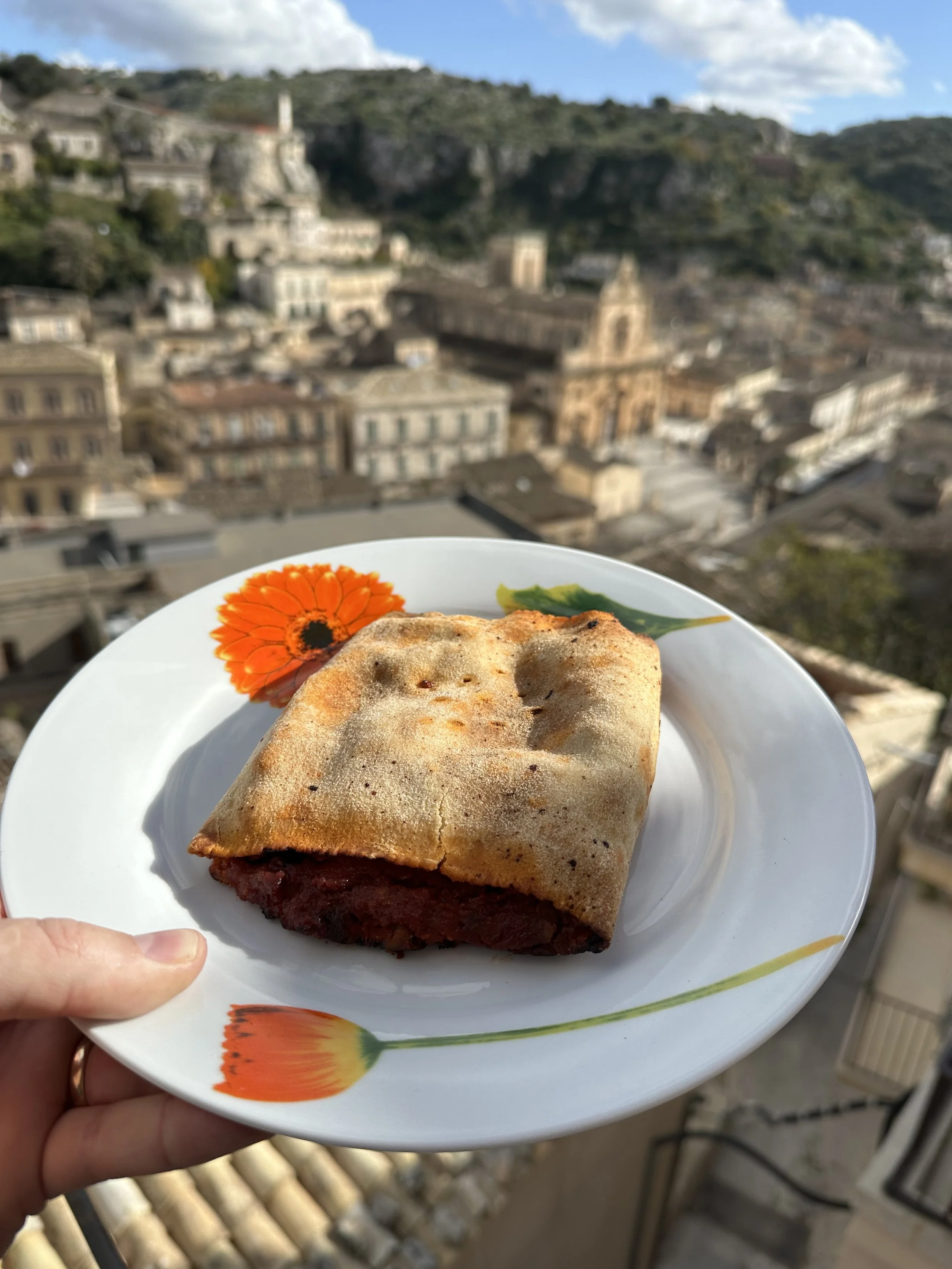
Scacce Modicane - the slimmer, lighter sibling to that of Ragusa
And now here I am, in Ragusa, finally meeting the dish on its own turf. No substitutions, no approximations, no British flour pretending to be Sicilian. Just a bakery counter, a sheet of dough rolled out thin and fillings folded in with the kind of muscle memory that comes from doing something your whole life. Holding a slice warm from the oven feels like closing the loop on a quiet obsession that’s followed me for five years.
What’s struck me since arriving in this part of Sicily however, is how scaccia isn’t an outlier. It belongs to a whole landscape of baked goods that are so local they sometimes don’t even travel to the next town. In Modica you’ll see scacce Modicane (note the difference in spelling), which is a thinner layered version and less rich than that of Ragusa. Impanate (or ‘mpanette depending which town you’re in), resembling a cross between an empanada and a Cornish pasty; filled with cauliflower, brocolli or aubergine. Ten minutes over a hill and the display changes entirely: different shapes, different fillings, different vocabulary.
A selection of baked goods at Panificio Giummarra, Ragusa
It’s one of the clearest reminders of how hyper-local Italian food really is. In the UK we often talk about “Italian cuisine” as if it’s one unified thing, but here the borders are drawn at the nearest ridge. A bakery in Ragusa folds its dough differently to one in Modica. A tomato filling that’s standard in one town is unthinkable in another. Even the way loaves are knotted or scored seems inherited, more family tradition than written recipe. That’s the charm: food that has stayed local, specific and stubbornly itself.
And it’s not just the bakeries. Even pizza rewrites itself here. At Daniele Baglieri’s pizzeria in Modica, I watched every assumption I had about what pizza “should” be fall away. Lighter bases, different techniques and dough fermentation, toppings that respect the land rather than trends. It’s a reminder that just when you think you know Italian food, something new taps you on the shoulder. That’s the thrill of it, in a world where almost everything is available everywhere and known, there are still pockets of Italy producing things so local, so particular, that they feel like discoveries.
Outstanding, fresh and inventive pizze (Padellino & Pensa Tonda Romana) at Daniel Baglieri Pizzeria, Modica. A must try!
Scaccia sits right at the heart of that. A dish that’s pretty unknown outside of this corner of Sicily, somehow finding me anyway and now finally, letting me come to it and in my quest, unearthing a whole other plethora of wonderful baked goods to taste and try and one day recreate myself.
The delicious cross-section of a Scaccia Ragusana
My Scaccia Ragusana Recipe
335g semolina flour
160ml lukewarm water
1 & 1/4 tsp sugar
1/4 tsp yeast
2 tbsp extra virgin olive oil
1/2 tsp sea salt
Flour for dusting
Mix the yeast, water and sugar and leave to sit for ten minutes. Then mix in the olive oil.
Separately, combine the flour and salt in a bowl. Add the wet ingredients and bring together. Knead for 5-8 minutes, until smooth. Add more water if the mix feels too dry.
Add the dough to a lightly oiled bowl and cover with cling film. Let it rise for approximately 2 hours, or until doubled in size.
Meanwhile make a basic tomato sauce and slice cheese/any other fillings (aubergine is popular in Sicily).
Heat the oven to full and roll out dough as thin as possible.
Fold and fill the dough using this video as a guide for the technique - https://youtu.be/CjJiVchocxA. Tuck underneath at the end to stop leakage.
Bake for around 50-60 mins at 200 degrees.
Let the scaccia rest for at least 5 minutes before cutting. Enjoy!
One of my prior attempts at Scaccia Ragusana - straight from the oven
A cross-section of my scaccia. Having now tried the real deal, I can’t wait to get home to tweak and develop my technique further.
Pandas and Poly Tunnels
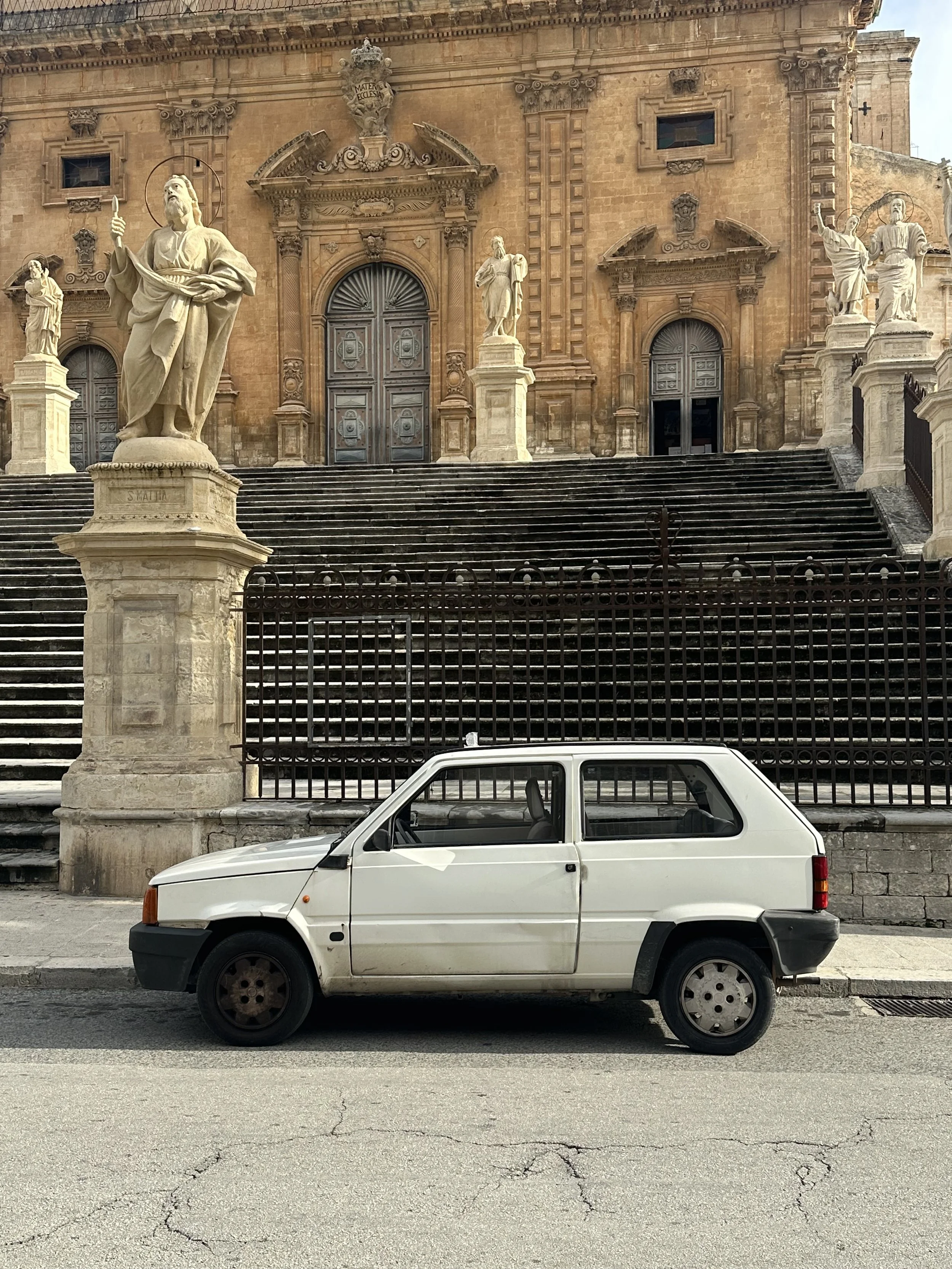
Departing town and dodging Fiat Pandas making illegal, yet excruciatingly slow, turns. A BMW fails to stop at a stop sign and I am grateful to be on high alert. Cars sit double parked along the pavement, blocking a lane of traffic. It is apparently fine because the hazard lights are on.
The road opens and follows the coast, with Sicily’s industrial edges, present. Bland apartment blocks rise beside littered streets. You will not find this on TikTok.
Departing town and dodging Fiat Pandas making illegal, yet excruciatingly slow, turns. A BMW fails to stop at a stop sign and I am grateful to be on high alert. Cars sit double parked along the pavement, blocking a lane of traffic. However, it is apparently fine, because the hazard lights are on.
The road opens and follows the coast, with Sicily’s industrial edges, present. Bland apartment blocks rise beside littered streets. You will not find this on TikTok.
At last the autostrada arrives and we enter big sky country. The low December sun lights up the endless viaducts, each one giving a steady drumbeat under the tyres as we pass over the joins. The elevated view reveals mountains with the occasional farmhouse and its modern neighbours: wind farms, scattered across the hillsides.
The rolling hills of Southern Sicily, near Gela
The road narrows back to a single carriageway as we exit into bright light from a tunnel, carved beneath a hulking rock. Traffic slows behind a lorry loaded with oranges that cannot keep pace with Sicilian impatience. Drivers ignore the no overtaking signs and take their chances to continue at speed.
The landscape shifts again and we return to the coast. The sea is almost close enough to touch and the golden beaches look inviting to an Englishman, still in awe of twenty degrees in winter.
Another town arrives. Another cavalcade of Fiat Pandas. Another test of hazard perception.
The ubiquitous Fiat Panda
The pace of travel quickens and so does the scenery. Rolling hills appear that would not look out of place in the Peak District, if it were not for the expanses of vines now wrapped in plastic after the harvest. A tight bend later and it becomes a sea of poly tunnels protecting tomatoes, aubergines and peppers. Over the next crest it is orange groves, bright and ready for their moment on the market stalls.
Then, almost without warning, you glide through another coastal town and repeat the rhythm of the journey until Modica reveals itself with its steep ravine and beautiful hillside, basking in the golden December sun - a picture postcard scene that does make its way onto social media. The journey to reach it is something that should not be overlooked, because this is the real Sicily: a land of sudden change, of harsh contrasts and of pure life.
Modica, basking in the December sun
The ceiling fans whip above our heads at an alarming rate, trying to keep pace with the mid-afternoon humidity as those of us sampling afternoon tea on the veranda at the Amangalla Hotel in Galle attempt to tread the fine line between refinement and simply keeping cool, all while downing cups of hot tea.
It is a slightly nostalgic afternoon for a period of time of which I have no living knowledge. Anemoia, as my musician friend Yarni would say.
The building itself has lived several lives. Once the headquarters of the Dutch East India Company, later Galle’s first hotel under British rule, and now a quietly polished luxury stay.
Like many places on the island, Sri Lanka still carries clues of its European colonial past.