Writing
Sri Lanka - Beauty & Discomfort
The ceiling fans whip above our heads at an alarming rate, trying to keep pace with the mid-afternoon humidity as those of us sampling afternoon tea on the veranda at the Amangalla Hotel in Galle attempt to tread the fine line between refinement and simply keeping cool, all while downing cups of hot tea.
It is a slightly nostalgic afternoon for a period of time of which I have no living knowledge. Anemoia, as my musician friend Yarni would say.
The building itself has lived several lives. Once the headquarters of the Dutch East India Company, later Galle’s first hotel under British rule, and now a quietly polished luxury stay.
Like many places on the island, Sri Lanka still carries clues of its European colonial past.
The ceiling fans whip above our heads at an alarming rate, trying to keep pace with the mid-afternoon humidity as those of us sampling afternoon tea on the veranda at the Amangalla Hotel in Galle attempt to tread the fine line between refinement and simply keeping cool, all while downing cups of hot tea.
It is a slightly nostalgic afternoon for a period of time of which I have no living knowledge. Anemoia, to quote my musician friend Yarni.
The building itself has lived several lives. Once the headquarters of the Dutch East India Company, later Galle’s first hotel under British rule, and now a quietly polished luxury stay.
Like many places on the island, Sri Lanka still carries clues of its European colonial past.
Old world luxury - Amangalla Hotel, Galle
In Pettah, a red post box inscribed with GR for King George sits almost unsuspectingly beside a bald car tyre filled with concrete. Even the humble custard cream, that quiet mainstay of the British biscuit tin, is readily available in supermarkets.
But the story here is not solely British.
At Geoffrey Bawa’s Colombo residence and at his country estate at Lunuganga, outside influences appear in more considered ways. Less in your face Mini Cooper energy, more quiet synthesis.
Born to a Sri Lankan father and Dutch mother, Bawa began life as a lawyer before turning later to architecture. What he left behind feels deeply deliberate. There is no pastiche here. No attempt to impose European forms wholesale onto tropical ground.
Instead, Bawa allows the space itself to do the work. Clear sightlines. Considered light. A calm sanctuary designed for thinking and for living.
His trophies are different too. Murano glass. Indian artwork. Fragments gathered from across the world and absorbed rather than imposed.
Geoffrey Bawa’s Lunuganga residence
Sri Lanka today feels like a country steadily finding its own feet. After years of internal strain, a modern identity is forming, unevenly but visibly.
Nowhere is this more apparent than along the southern coast, where development and tourist appetite sometimes appear to be outpacing the infrastructure beneath them. Hastily built beachside accommodation sits beside small local shacks selling fruit, snacks, or lottery tickets.
And then an Ashok Leyland bus roars past, and the old world briefly returns once more.
Workers at the Dambatenne Tea Factory
Travel a couple of hours north of the beaches of the south coast and you reach the tea country at Uva. Another relic of the past, where the country’s first commercial tea bushes were planted by the British. By the early twentieth century, the vast estates that remain today were already in place.
A visit to Dambatenne tea factory, built in 1890 by a Scot, Thomas Lipton, furthers this feeling of the old world. Not only is the factory still standing, but much of the British-made machinery within it remains in operation. Our tour guide was incredibly keen to show these off to ourselves, from the UK.
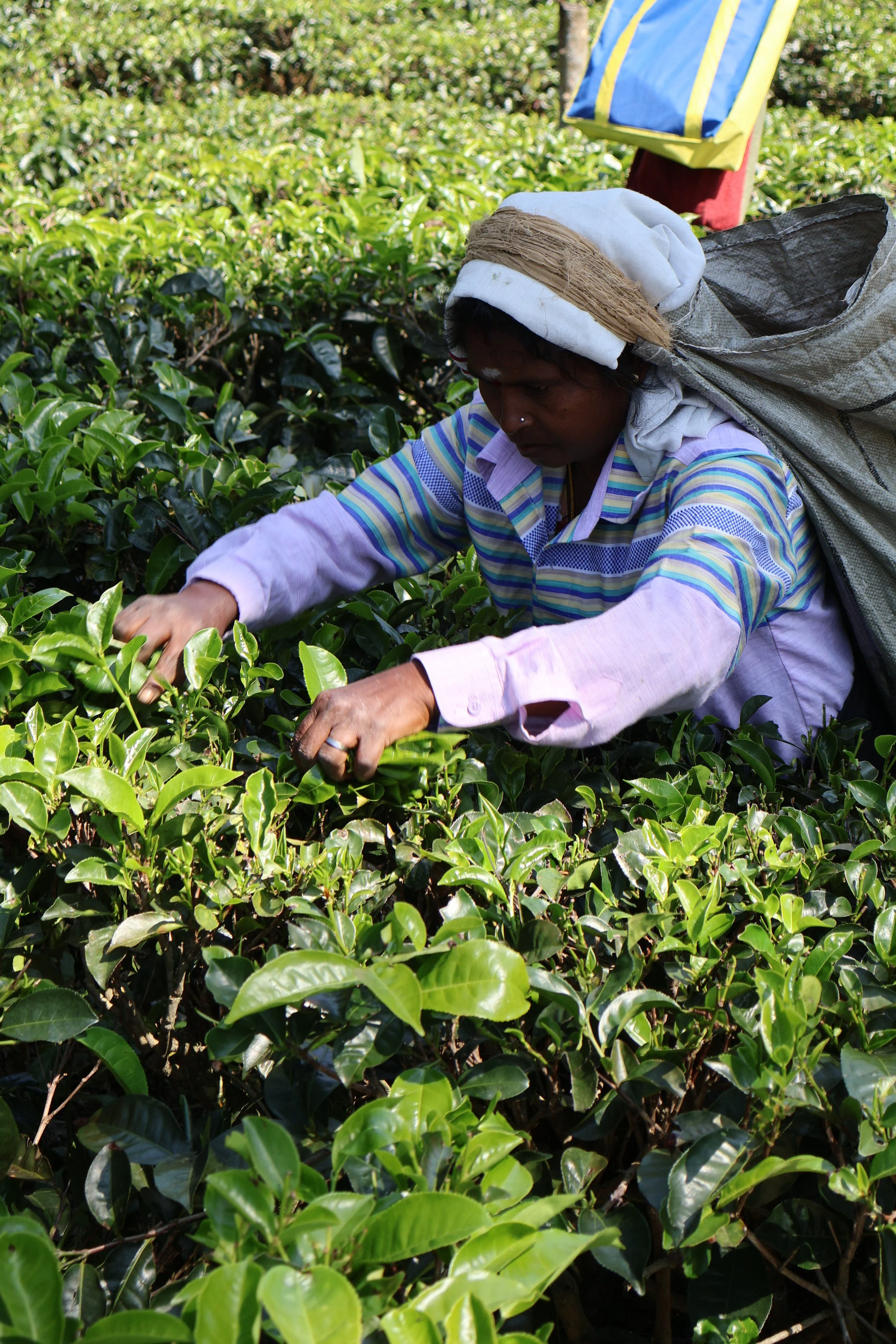
However, here too, the stark contrasts of Sri Lanka loom large as workers tirelessly labour in questionable conditions for the equivalent of around £3.60 a day. A reminder that cosplaying with nostalgia has very real downsides for those in the thick of the reality of real life.
It isn’t only ornate architecture, beautiful design and tea-drinking rituals. There is a real human element at play, one where people are exploited today just as they were back then.
Tea plantation worker in the hills near Ella
It makes me think about how morally difficult it can sometimes feel being a tourist. The natural curiosity and delight of catching a glimpse into a time you didn’t experience; often via small, real-time moments, albeit in modern clothes and modern technology - sits awkwardly beside an awareness of the hardship faced by others.
The balance between bringing much-needed outside money and avoiding the temptation to turn a day trip into a photoshoot of poverty.
Most people don’t like to be uncomfortable when they travel, but perhaps discomfort is an unavoidable part of seeing the world honestly. Something to learn from, to grow from and to try and affect positively, in your own little way. An opportunity to appreciate beauty whilst also recognising and respecting the difficulties that others live with every day.
As Anthony Bourdain once put it:
“Travel is not always pretty. It is not always comfortable. Sometimes it hurts, it even breaks your heart. But that’s okay. The journey changes you; it should change you.”
Railway relics from another era
*All photos used were done so with the permission of those photographed*
If you enjoyed this, you might like the below too…
Rain…I don’t mind
Usually, a rainy day would put me in a bad mood. Perhaps surprising, given I come from the north of England, but it’s never something one really looks forward to, especially when travelling in the hope of sunny climes.
And yet, on this latest trip, I’ve noticed a shift in mindset. Rainy days no longer bring the same sense of mardiness they once did. Of course, they can be a welcome relief from the heat, but more importantly they feel like nature’s way of saying, have a day off.
Usually, a rainy day would put me in a bad mood. Perhaps surprising, given I come from the north of England, but it’s never something one really looks forward to, especially when travelling in the hope of sunny climes.
And yet, on this latest trip, I’ve noticed a shift in mindset. Rainy days no longer bring the same sense of mardiness they once did. Of course, they can be a welcome relief from the heat, but more importantly they feel like nature’s way of saying, have a day off.
A wet day means fewer possibilities. No long sightseeing loops, no afternoon spent lying on a beach, comatose under the sun. Instead, it gently forces your hand towards the quieter things. The life admin. The laundry. Sorting through the ridiculous number of photographs you’ve taken. Or finally sitting down and finding your rhythm with writing again.
Like life itself, even the most idyllic stretches have a gloomy day now and again. And while it’s never wise to ignore how we feel, rain has become a small reminder that time still passes, plans still shift, and there are often quiet positives to be found in moments that initially feel like a disappointment.
Sometimes, all you need is permission to slow down.
If you enjoyed this, you might like the below too…
Pandas and Poly Tunnels
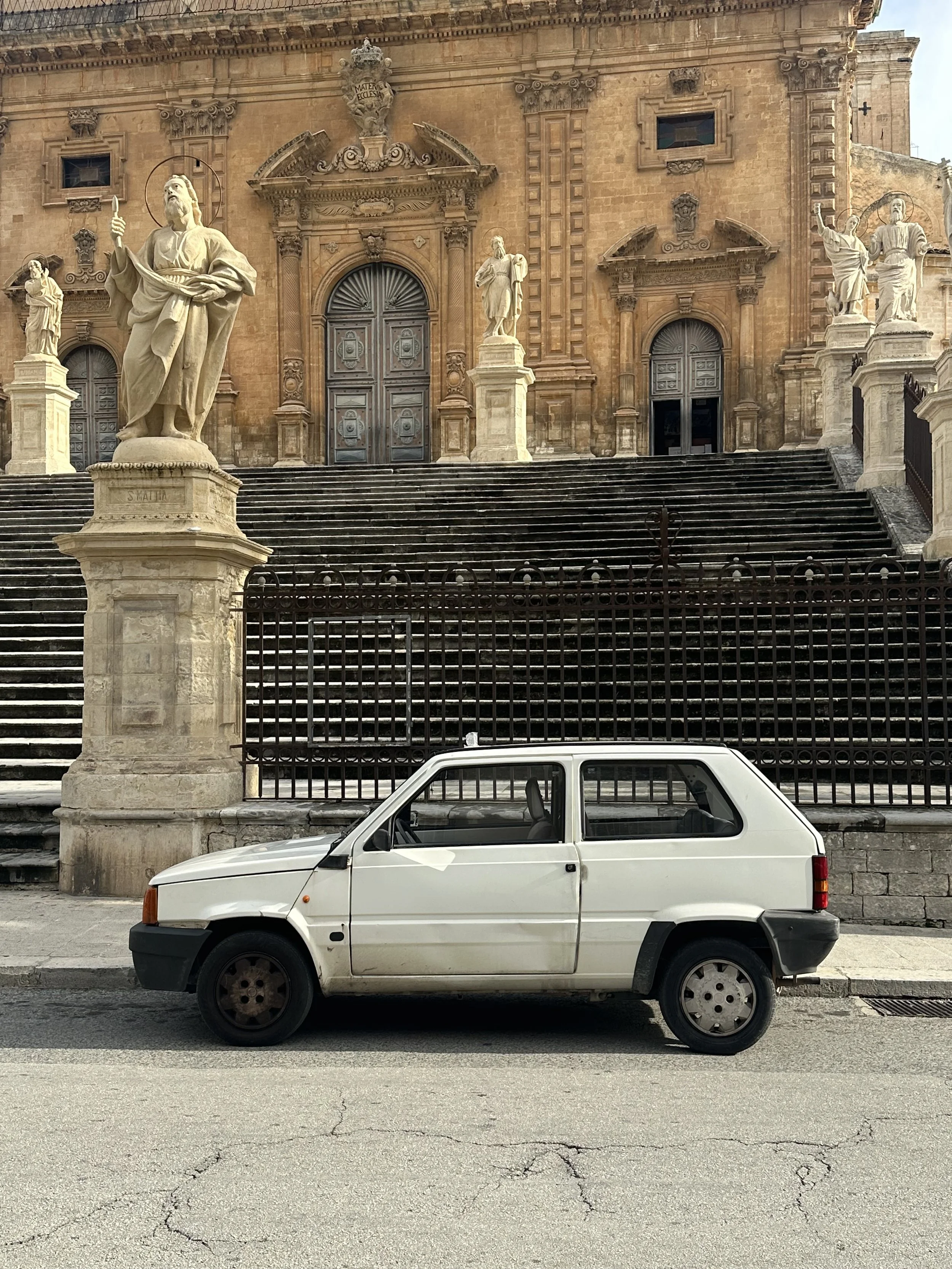
Departing town and dodging Fiat Pandas making illegal, yet excruciatingly slow, turns. A BMW fails to stop at a stop sign and I am grateful to be on high alert. Cars sit double parked along the pavement, blocking a lane of traffic. It is apparently fine because the hazard lights are on.
The road opens and follows the coast, with Sicily’s industrial edges, present. Bland apartment blocks rise beside littered streets. You will not find this on TikTok.
Departing town and dodging Fiat Pandas making illegal, yet excruciatingly slow, turns. A BMW fails to stop at a stop sign and I am grateful to be on high alert. Cars sit double parked along the pavement, blocking a lane of traffic. However, it is apparently fine, because the hazard lights are on.
The road opens and follows the coast, with Sicily’s industrial edges, present. Bland apartment blocks rise beside littered streets. You will not find this on TikTok.
At last the autostrada arrives and we enter big sky country. The low December sun lights up the endless viaducts, each one giving a steady drumbeat under the tyres as we pass over the joins. The elevated view reveals mountains with the occasional farmhouse and its modern neighbours: wind farms, scattered across the hillsides.
The rolling hills of Southern Sicily, near Gela
The road narrows back to a single carriageway as we exit into bright light from a tunnel, carved beneath a hulking rock. Traffic slows behind a lorry loaded with oranges that cannot keep pace with Sicilian impatience. Drivers ignore the no overtaking signs and take their chances to continue at speed.
The landscape shifts again and we return to the coast. The sea is almost close enough to touch and the golden beaches look inviting to an Englishman, still in awe of twenty degrees in winter.
Another town arrives. Another cavalcade of Fiat Pandas. Another test of hazard perception.
The ubiquitous Fiat Panda
The pace of travel quickens and so does the scenery. Rolling hills appear that would not look out of place in the Peak District, if it were not for the expanses of vines now wrapped in plastic after the harvest. A tight bend later and it becomes a sea of poly tunnels protecting tomatoes, aubergines and peppers. Over the next crest it is orange groves, bright and ready for their moment on the market stalls.
Then, almost without warning, you glide through another coastal town and repeat the rhythm of the journey until Modica reveals itself with its steep ravine and beautiful hillside, basking in the golden December sun - a picture postcard scene that does make its way onto social media. The journey to reach it is something that should not be overlooked, because this is the real Sicily: a land of sudden change, of harsh contrasts and of pure life.
Modica, basking in the December sun
Eerie Erice
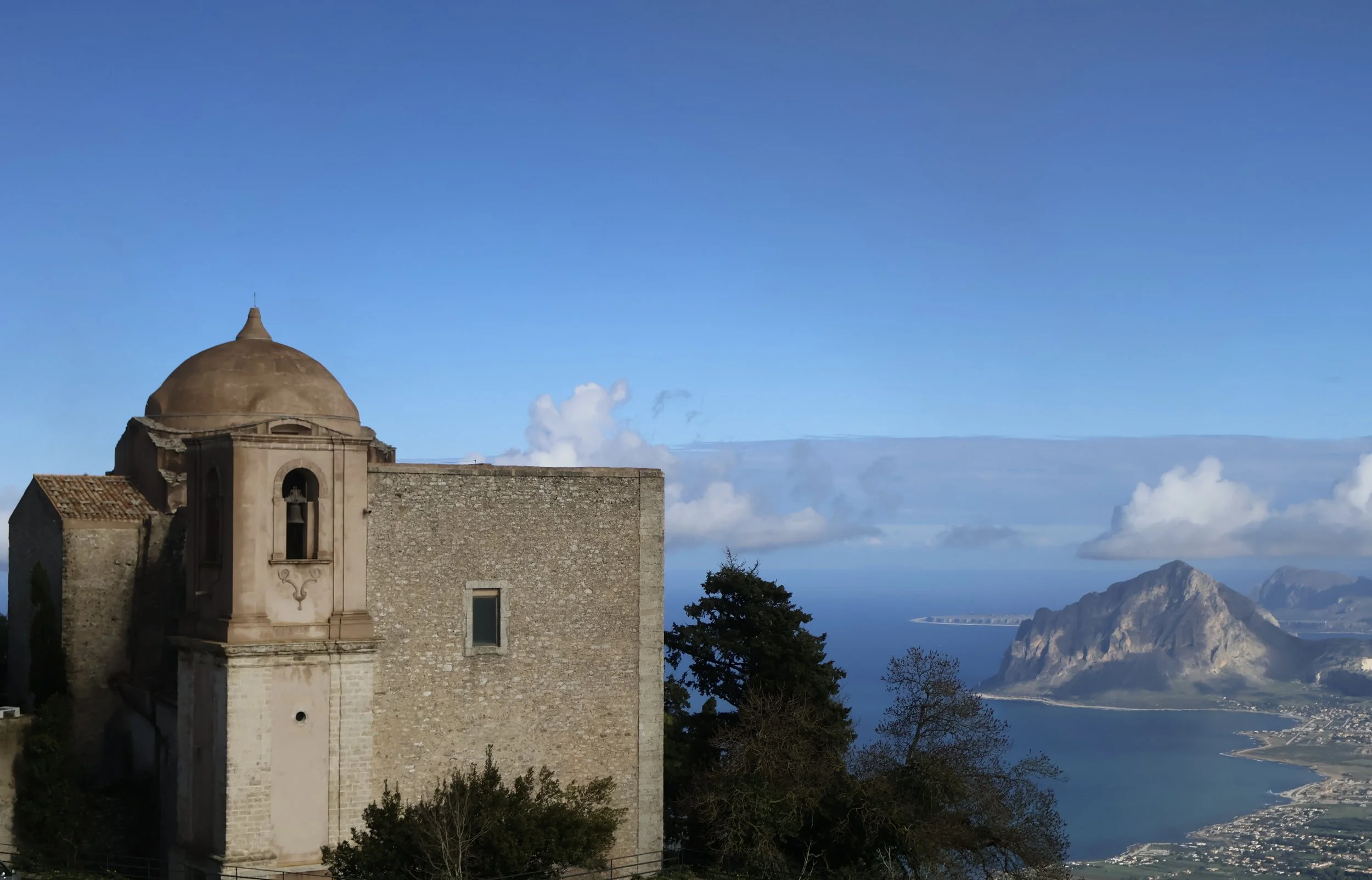
We’re driving through the outskirts of Trapani. A rain shower passes over as quickly as it came, a common theme for this part of the north western Sicilian coastline in late November. The windscreen wipers begin to slow and the sun shines bright, glistening off the road.
Monte Erice ahead of us, still shrouded in a heavy, thick cloud; brooding above.
We’re driving through the outskirts of Trapani. A rain shower passes over as quickly as it came, a common theme for this part of the north western Sicilian coastline in late November. The windscreen wipers begin to slow and the sun shines bright, glistening off the road.
Monte Erice ahead of us, still shrouded in a heavy, thick cloud; brooding above.
We begin the never-ending climbs of twists and turns up the mountain and I’m thankful for having hired a car with an automatic gearbox. We pass incredibly brave (or daft) cyclists making their way up 2,461 ft climb. The sun is glistening down on the city of Trapani, below and we have a clear view across to the Egadi Islands.
We begin to reach the summit and within a turn of a hairpin bend, the infamous cape of fog and mist that envelopes Erice in morning hits us. I make a bad quip about Erice being eerie as I pull into a car parking space by Porta Trapani that seems to have been marked out using a Smart Car as the optimal size of vehicle for its use.
We head up the steep hill from the car park in search of a sweet breakfast at the infamous Pasticceria Maria Grammatico. The slippery footpath like glass from the earlier downpour and horizon barely visible, we finally reach our target and some sugary, caffeine fuelled solitude.
It’s quiet when we enter and the feeling of being part of a noir tv drama series is only intensified by the wonderfully old fashioned decor of the pasticceria - wood panelled walls and a large collection of foreign currency and Catholic saints a backdrop to the large, sweeping counter that’s full of Sicilian treats.
We have our cappuccino and share a few bits from the counter - a still warm crema Genonvesi, a slice of Torta alle Amarene and piece of Crostata al Pistachio. Our eyes being bigger than our bellies, we wrap some away for ‘later’ and head out into the street, past the group of cyclists we’d passed earlier on the road up and into a now slightly clearer Erice.
The fog and mist lift to add even further sense of cinematography to an already picturesque town. We tread delicately on the slippery stone streets and reach the north-eastern edge of the town to be blown away by the dramatic landscape towards San Vito Lo Capo. Clouds suspended mid air and running quickly along the vista of the hills below and the sea beyond.
An incredible vista towards San Vito Lo Capo, from Erice
The eeriness of the climate and landscape only continuing as we walked around to Castello del Bálio where we stood above a blanket of swirling cloud, obscuring the view to the south and Marsala with just the odd glimpse of a field a couple of thousand feet beneath.
We continue walking back through the main heart of the town. Past a church with its doors open - a Virgin Mary statue illuminated in the doorway to welcome in visitors and along more winding street with dark semi derelict houses only adding to the mystique as the clouds and mist envelop the town once more. A cold dampness setting into the air.
The mist and noir sets in once more as we head back to our car
Erice was a truly remarkable place that surpassed all my expectations and if it hadn’t been for tiredness and a slight anxiety about the car being parked in a space that’d have been small for Noddy’s car, whilst being fully aware of many Italian’s inability to drive carefully, we would have stayed for longer. Alas, we left feeling grateful for the experience as we snaked our way back down Monte Erice.
I mercati di Palermo
Anthony Bourdain once said that the real heart of a place is found in its markets and that if you want to understand a culture, you should go where people shop and eat every day.
I have always agreed with him. Whenever I travel somewhere new, the market is my first stop. Spend twenty minutes wandering between the stalls and you get an instant sense of what is in season, what is local, and what you should be ordering later at dinner.
Anthony Bourdain once said that the real heart of a place is found in its markets and that if you want to understand a culture, you should go where people shop and eat every day.
I have always agreed with him. Whenever I travel somewhere new, the market is my first stop. Spend twenty minutes wandering between the stalls and you get an instant sense of what is in season, what is local, and what you should be ordering later at dinner.
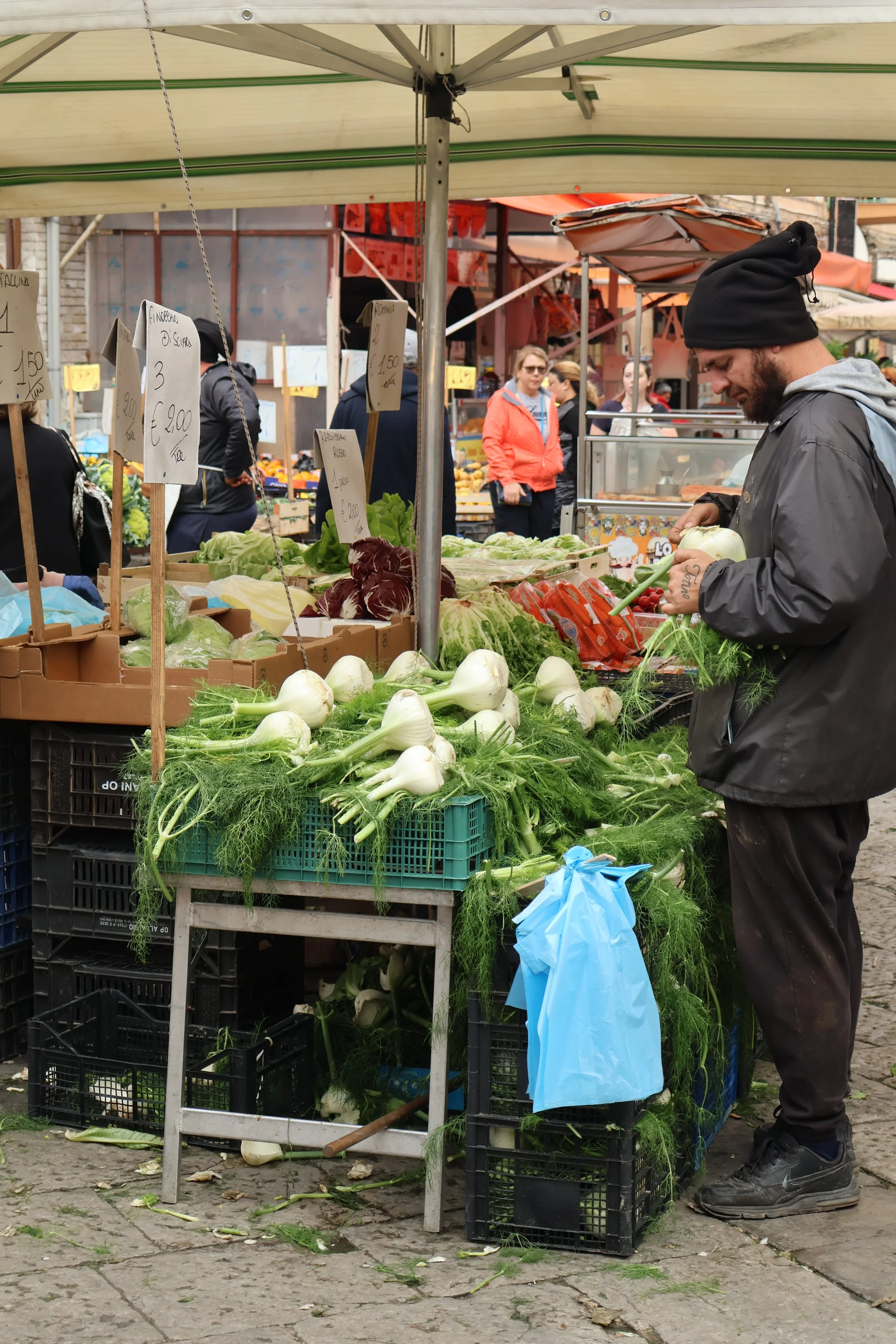
Here in Palermo, returning to Mercato Capo and Ballaró has been every bit as exhilarating as I remembered from three years ago. Both run along narrow streets through the centre of the city, a jumble of makeshift stands and permanent shopfronts tucked beneath the golden stone apartments above.
It can feel like controlled disorder. Teenagers on mopeds inch their way down corridors of people. A car turns down the wrong lane and has to roll over a mountain of discarded cauliflower leaves to escape. Voices carry from every direction, thick with Sicilian dialect that hints at the island’s history with North Africa and the Middle East.
Music fills the gaps, especially at Ballaró where Italian pop blares from speakers and stallholders dance as they serve panelle con pane. One man I remembered instantly from our last trip, famed in my mind for turning meat with his bare hands, shouts a compliment at my wife with full theatrical hand gestures. Palermo knows how to put on a show.
It is a full sensory hit, equal parts spectacle and obstacle course. Yet this time, something is different. The heat has eased. It is late autumn now, a comfortable twenty rather than the humid mid thirties. And the crowds have thinned. Gone are the tourist groups drifting toward restaurants plastered with photos of lasagne. In their place are locals comparing prices, debating the best way to cook something, offering advice nobody asked for but everyone expects.
The produce has shifted too. Where figs, melons and aubergines once dominated, the stalls are now piled high with fennel, cauliflower, and the bright citrus that defines Sicilian cooking. Oranges everywhere.
With space to breathe, choosing what to buy feels more deliberate. Ideas come fast, matching the energy of the markets themselves. And despite the flood of possibilities, the decision more or less makes itself: swordfish, still local and still in season, paired with a crisp fennel and orange salad and finished with chopped pistachio from Bronte.
Simple. Obvious. Perfectly Sicilian.
Midnight in Sicily
Our plane begins its descent into Palermo. The curve of the bay glows on our left, a soft necklace of lights against the dark water, while the mountains stand brooding around the city.
We’re back in Sicily. The still warm November air hits us as we alight the plane - a small announcement that we’ve left behind the cold, wet, grey of England and arrived somewhere that shares more DNA with North Africa than with Rome.
We take a (dangerously) quick cab into the city, along the highway where the Judge Giovanni Falcone’s car was blown apart by La Cosa Nostra, in 1992. I recall to the last time I was here, reading Midnight in Sicily and learning how a place so beautiful could carry such deep scars. How the island is a complicated subversive web of criminality and the law and not always necessarily fitting the bad and good tags that you’d associate with either.
There’s something undeniably pleasing about driving into a city at night. Streets hushed and shrouded in darkness. A solitary window lit by the bluish light of a TV. A tiny orange ember hovering outside a doorway where someone smokes. Traffic lights flipping colours like painted brushstrokes. A bar glowing softly, making you wonder what stories are unfolding inside. Landmarks illuminated like canvases in a quiet gallery, stripped of the crowds that swarmed them only hours earlier. A couple stepping out of a warm trattoria into the night, still slipping on their jackets.
Then there’s the AirBnb arrival ritual. You step out of the taxi hoping you gave the driver the right address, because nothing looks the same as it did on Google Street View. Nothing ever does at night. There’s the familiar dance with key codes and lockboxes, followed by the discovery that the building has no lift and both 20kg suitcases need to be hauled up four flights of narrow, badly lit stairs.
But then you open the door, and the place does look like the photos. Relief washes in: you haven’t been conned, and you can finally stop. After hours of travelling, of queuing for security, of boarding by standing in stairwells for no logical reason, of buying that unnecessary airport pint because what else is there to do for forty minutes and you can finally exhale.
The trip starts now. After a night of sleep in a strange bed, tomorrow it will truly begin.
The ceiling fans whip above our heads at an alarming rate, trying to keep pace with the mid-afternoon humidity as those of us sampling afternoon tea on the veranda at the Amangalla Hotel in Galle attempt to tread the fine line between refinement and simply keeping cool, all while downing cups of hot tea.
It is a slightly nostalgic afternoon for a period of time of which I have no living knowledge. Anemoia, as my musician friend Yarni would say.
The building itself has lived several lives. Once the headquarters of the Dutch East India Company, later Galle’s first hotel under British rule, and now a quietly polished luxury stay.
Like many places on the island, Sri Lanka still carries clues of its European colonial past.