Writing
Sri Lanka - Beauty & Discomfort
The ceiling fans whip above our heads at an alarming rate, trying to keep pace with the mid-afternoon humidity as those of us sampling afternoon tea on the veranda at the Amangalla Hotel in Galle attempt to tread the fine line between refinement and simply keeping cool, all while downing cups of hot tea.
It is a slightly nostalgic afternoon for a period of time of which I have no living knowledge. Anemoia, as my musician friend Yarni would say.
The building itself has lived several lives. Once the headquarters of the Dutch East India Company, later Galle’s first hotel under British rule, and now a quietly polished luxury stay.
Like many places on the island, Sri Lanka still carries clues of its European colonial past.
The ceiling fans whip above our heads at an alarming rate, trying to keep pace with the mid-afternoon humidity as those of us sampling afternoon tea on the veranda at the Amangalla Hotel in Galle attempt to tread the fine line between refinement and simply keeping cool, all while downing cups of hot tea.
It is a slightly nostalgic afternoon for a period of time of which I have no living knowledge. Anemoia, to quote my musician friend Yarni.
The building itself has lived several lives. Once the headquarters of the Dutch East India Company, later Galle’s first hotel under British rule, and now a quietly polished luxury stay.
Like many places on the island, Sri Lanka still carries clues of its European colonial past.
Old world luxury - Amangalla Hotel, Galle
In Pettah, a red post box inscribed with GR for King George sits almost unsuspectingly beside a bald car tyre filled with concrete. Even the humble custard cream, that quiet mainstay of the British biscuit tin, is readily available in supermarkets.
But the story here is not solely British.
At Geoffrey Bawa’s Colombo residence and at his country estate at Lunuganga, outside influences appear in more considered ways. Less in your face Mini Cooper energy, more quiet synthesis.
Born to a Sri Lankan father and Dutch mother, Bawa began life as a lawyer before turning later to architecture. What he left behind feels deeply deliberate. There is no pastiche here. No attempt to impose European forms wholesale onto tropical ground.
Instead, Bawa allows the space itself to do the work. Clear sightlines. Considered light. A calm sanctuary designed for thinking and for living.
His trophies are different too. Murano glass. Indian artwork. Fragments gathered from across the world and absorbed rather than imposed.
Geoffrey Bawa’s Lunuganga residence
Sri Lanka today feels like a country steadily finding its own feet. After years of internal strain, a modern identity is forming, unevenly but visibly.
Nowhere is this more apparent than along the southern coast, where development and tourist appetite sometimes appear to be outpacing the infrastructure beneath them. Hastily built beachside accommodation sits beside small local shacks selling fruit, snacks, or lottery tickets.
And then an Ashok Leyland bus roars past, and the old world briefly returns once more.
Workers at the Dambatenne Tea Factory
Travel a couple of hours north of the beaches of the south coast and you reach the tea country at Uva. Another relic of the past, where the country’s first commercial tea bushes were planted by the British. By the early twentieth century, the vast estates that remain today were already in place.
A visit to Dambatenne tea factory, built in 1890 by a Scot, Thomas Lipton, furthers this feeling of the old world. Not only is the factory still standing, but much of the British-made machinery within it remains in operation. Our tour guide was incredibly keen to show these off to ourselves, from the UK.
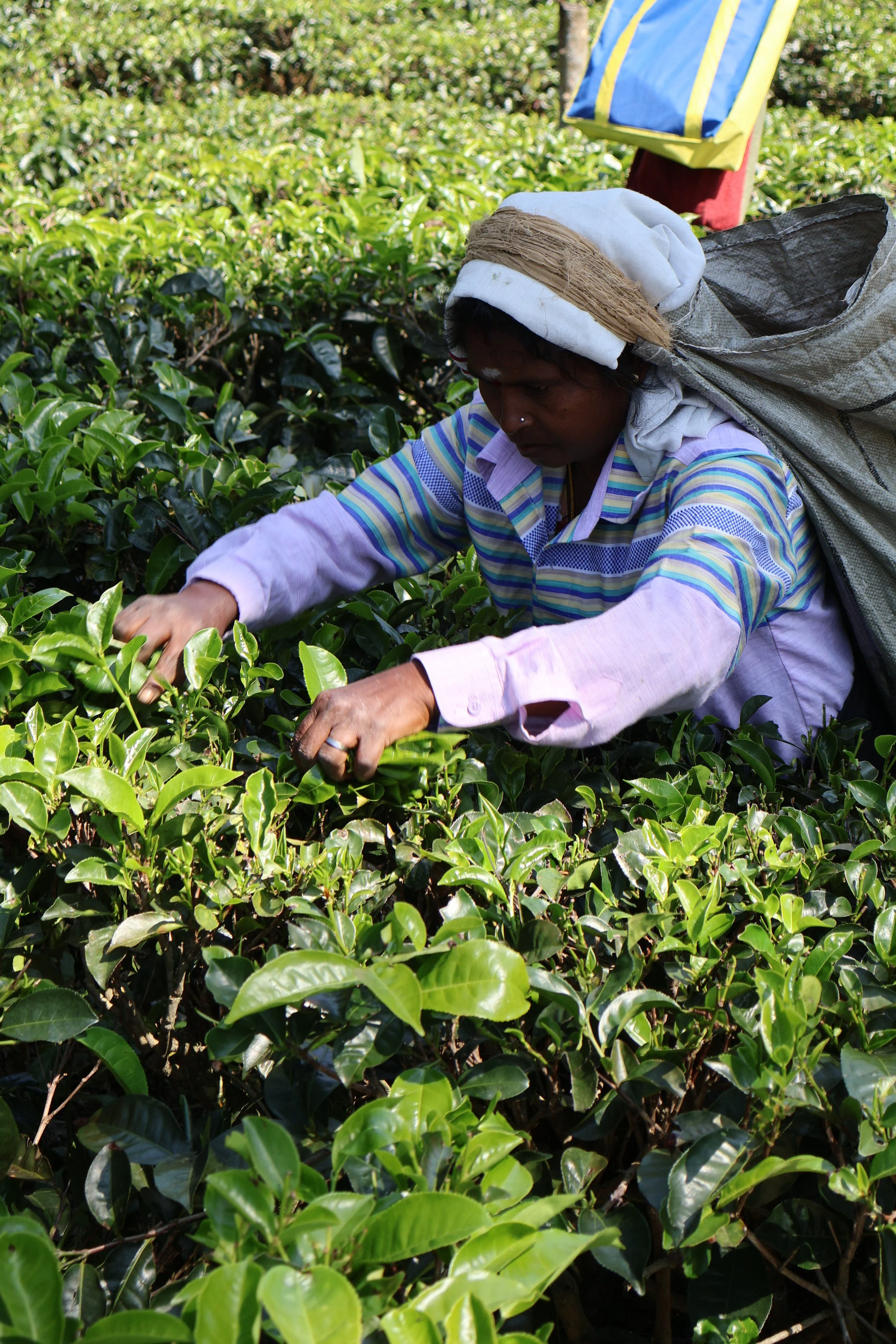
However, here too, the stark contrasts of Sri Lanka loom large as workers tirelessly labour in questionable conditions for the equivalent of around £3.60 a day. A reminder that cosplaying with nostalgia has very real downsides for those in the thick of the reality of real life.
It isn’t only ornate architecture, beautiful design and tea-drinking rituals. There is a real human element at play, one where people are exploited today just as they were back then.
Tea plantation worker in the hills near Ella
It makes me think about how morally difficult it can sometimes feel being a tourist. The natural curiosity and delight of catching a glimpse into a time you didn’t experience; often via small, real-time moments, albeit in modern clothes and modern technology - sits awkwardly beside an awareness of the hardship faced by others.
The balance between bringing much-needed outside money and avoiding the temptation to turn a day trip into a photoshoot of poverty.
Most people don’t like to be uncomfortable when they travel, but perhaps discomfort is an unavoidable part of seeing the world honestly. Something to learn from, to grow from and to try and affect positively, in your own little way. An opportunity to appreciate beauty whilst also recognising and respecting the difficulties that others live with every day.
As Anthony Bourdain once put it:
“Travel is not always pretty. It is not always comfortable. Sometimes it hurts, it even breaks your heart. But that’s okay. The journey changes you; it should change you.”
Railway relics from another era
*All photos used were done so with the permission of those photographed*
If you enjoyed this, you might like the below too…
Paradise Isn’t Always Quiet
A loud rumble of a vehicle passes close to my right side as I walk along the dusty, dry street, narrowly avoiding uneven slabs of pavement and stepping over open drain covers.
Welcome to the hustle of southern Sri Lanka. A place where beautiful seas and beaches sit in uneasy tandem with the overcrowded coastal road. Where nature is in direct competition with humanity’s relentless pursuit of growth at all costs.
A loud rumble of a vehicle passes close to my right side as I walk along the dusty, dry street, narrowly avoiding uneven slabs of pavement and stepping over open drain covers.
Welcome to the hustle of southern Sri Lanka. A place where beautiful seas and beaches sit in uneasy tandem with the overcrowded coastal road. Where nature is in direct competition with humanity’s relentless pursuit of growth at all costs.
A simple walk to the shop for water often turns into an assault course for the senses. A Leyland Ashok bus hurtles through town at unnecessary speed, brushing the already heavy air across your body with even greater intensity, as a seemingly endless fleet of tuk tuks passes by asking if you need a ride.
After almost two weeks away, the prospect of returning to the beach brings a flicker of excitement.
It doesn’t last long.
Ashok Leyland Bus - A Sri Lankan menace
I’d read the beach would be busy with people drawn by the turtles, but I hadn’t expected quite this. Masses of people huddle around the giant animals at the shoreline, lured in by food bought from beach vendors and tossed into the shallows. Visitors crowd around, phones raised, inappropriate poses readied and edging closer and closer.
On one occasion my wife pulls a plastic bag (used for the aforementioned food) from the water, left drifting where a turtle might easily have swallowed it. Nearby, she gently but firmly tells a woman to stop pushing one of the animals for a better photo.
It feels wrong. Upsetting. A little hollow.
A circus, not the quiet encounter with wildlife I had imagined.
It reminds me that travel isn’t always soft edges and easy beauty.
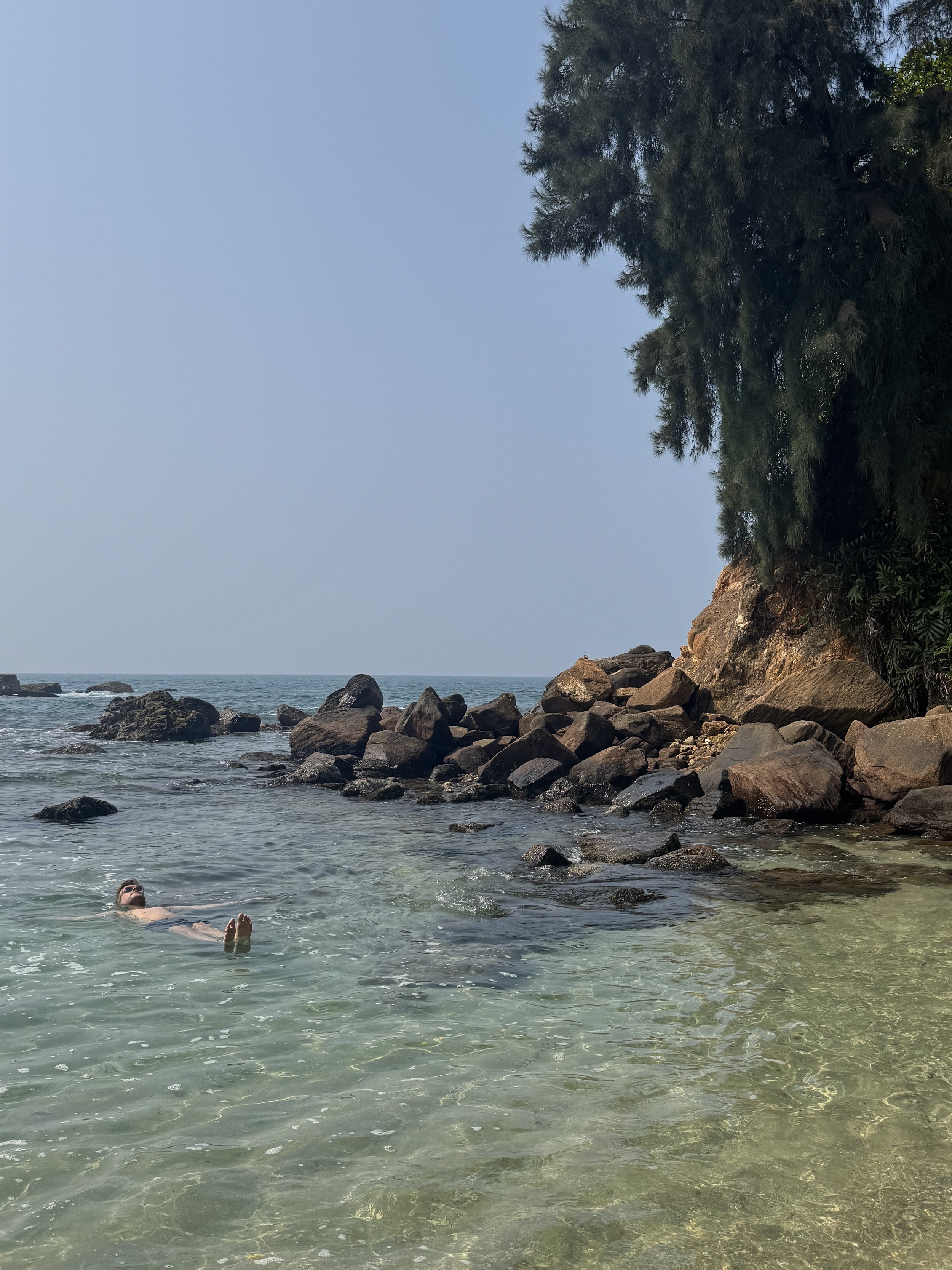
Relaxation at Ahangama Secret Beach
Two days later we finally find a beach that ticks the most important boxes: quiet, safe and calm. We decompress almost immediately. Each sip of the chilled king coconut from the nearby beach hut a literal tonic to the heat exhaustion.
The repetition of sea-sunbathe-sea-hydrate becoming a seductive mantra for relaxation and unwinding. The day passes slowly and upon returning to the main road, there’s almost a feeling of the outside world being one of calm. And then it hits you again - the offers of a tuk tuk ride, hurtling blue buses and weaving mopeds. The sea breeze is behind you and it’s a race back to the comfort of the air conditioned room for respite.
The cycle continues for a few days and we settle into a nicely compromised daily ritual. Morning light and walks. A cafe. Then to the beach before returning for a rest and then braving the busy streets once more for our evening meal.
Respite at The Kip, Ahangama
We depart the south coast and head to Udawalawe National Park and the following day take a safari.
Our jeep crawls through winding jungle roads past tropical birds and groups of monkeys who look like that incredibly ugly bloke we all know. Over bumpy tracks into vast watery plains with colourful peacocks and gurning water buffalo (there’s the ugly man again!).
And finally, the king of Udawalawe. The elephant.
We see a few lone males and small family groups along the way, but nothing beat the final roll of the dice when we turned down a quiet back road and stumbled upon a small herd eating and bathing in the muddy water.
Total bliss just sitting in silence. The only sound being the spraying of water and mud onto their hot brown skin, watching these beautiful creatures go about their day peacefully from touching distance.
And at that moment I realise just how much noise we had been carrying inside and what paradise really means to me.
Elephants bathing in the mud, Uduwalawe
If you enjoyed this, you might like the below too…
Pettah Go Early
Long before the crowds and chaos, there is a moment of calm. A stillness. An unexpected beauty.
My tuk tuk comes to an abrupt stop outside the Jami-Ul-Afar Mosque in Colombo’s Pettah district. It’s early on a Sunday morning and I am here to take some photos of this colourful area before it all gets too much.
The air is heavy following a downpour overnight. The clouds are thick and grey and puddles linger at the side of the road. I step over one to reach the relative safety of the pavement across from the ‘Red Mosque’, a jewel in Colombo’s architectural crown.
Long before the crowds and chaos, there is a moment of calm. A stillness. An unexpected beauty.
My tuk tuk comes to an abrupt stop outside the Jami-Ul-Afar Mosque in Colombo’s Pettah district. It’s early on a Sunday morning and I am here to take some photos of this colourful area before it all gets too much.
The air is heavy following a downpour overnight. The clouds are thick and grey and puddles linger at the side of the road. I step over one to reach the relative safety of the pavement across from the ‘Red Mosque’, a jewel in Colombo’s architectural crown.
The road between me and the mosque is quiet. A few locals pass by and I’m conscious of their glancing looks as I pace up and down, trying to find my amateur photographer’s best angle to show off the beauty of the tiled building before me.
The ‘Red Mosque’. Jami-Ul-Afar, Colombo
While I do so, a small crowd approaches the mosque and I realise it’s a wedding photo shoot. I hang back and muster the confidence to take a photo of the happy couple, stood outside the entrance. I watch on with no real purpose and then, after a short while, find the nerve to attempt a shot of the pair holding hands, through the window of a passing tuk tuk. I somehow manage it first time and I’m quietly thrilled that my fairly limited technical ability with a camera pays off.
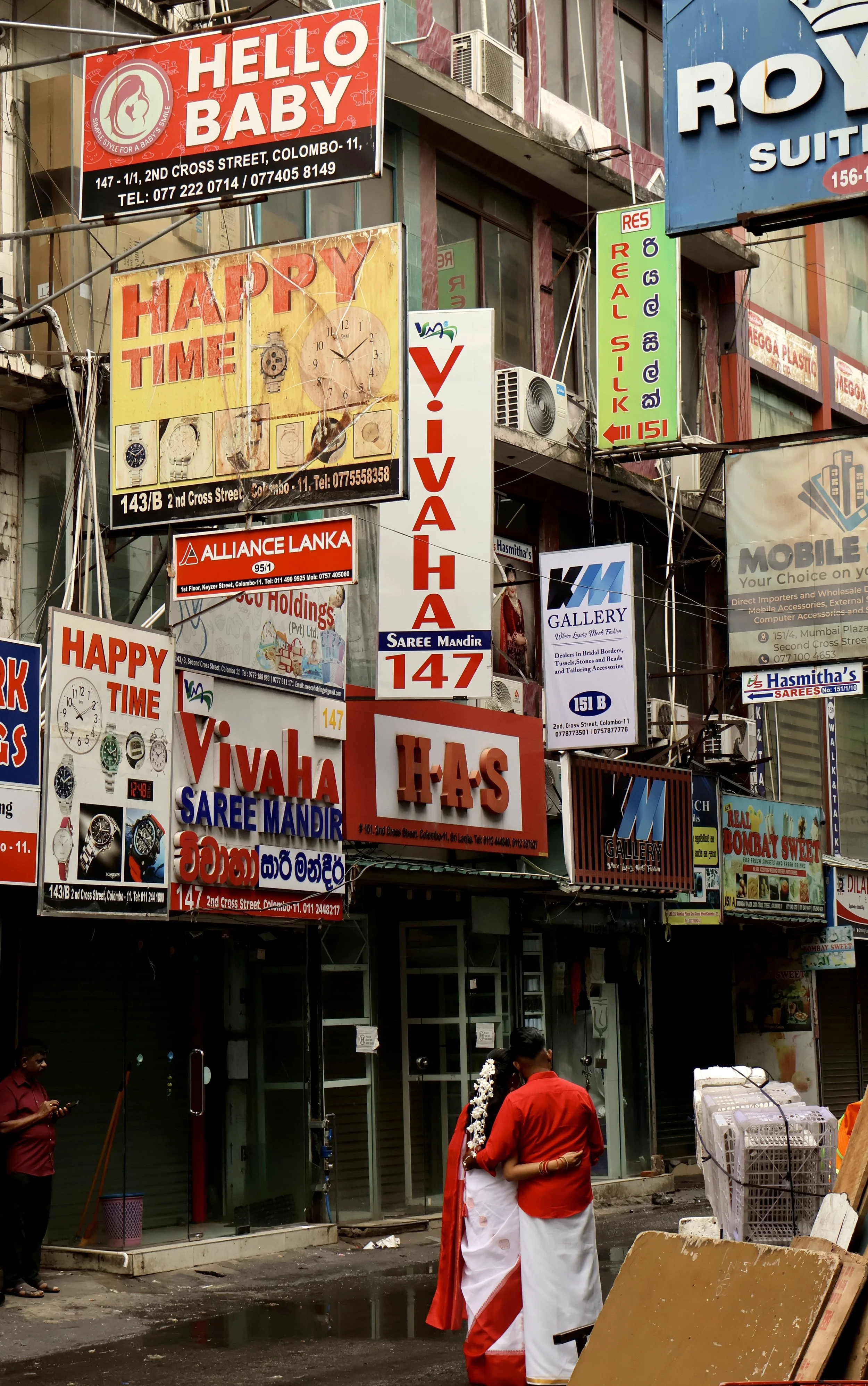
I walk on and head to explore the surrounding streets. Down 2nd Cross Street it is still quiet, but things are beginning to stir as market vendors set up their stalls for the day. I have a clear view of the jumble of signs fighting for attention from the buildings lining the street, advertising everything from clothing, to watches, to baby items.
The happy couple through a tuk tuk
King George VI red postbox, Pettah.
I’m relieved I came early and have the bandwidth to take it all in without the crowds. This time of day is maybe my favourite for getting out and walking. Right on the cusp of things starting to happen and a sense of possibility and excitement for the day ahead. A literal awakening of the day.
At an intersection I spot a red King George post box and think briefly of home. As I turn around, I see yet another newlywed couple having their photos taken right in the middle of the street. I hold back to give them space and continue on along Prince Street.
Love amongst the chaos, Pettah. Colombo.
Market porter on the move. Pettah Market.
Market porters now pass with increasing regularity, pushing goods on large trolleys and dodging the big puddles. A Chinese tour group of photographers walks by and says hello as I duck into the small passageways off the main thoroughfare, marvelling at the vivid red signs and retro typography.
Then I notice my smugness beginning to fade. I’ve made the rookie error of not checking my camera battery before setting off.
I loop back towards the mosque via 1st Cross Street. An old lady walks ahead of me, framed by towering yellow cranes at the nearby port. I’d almost forgotten I was by the sea, but being out at this time has given me the space to observe and to settle back into myself.
My camera battery finally dies and I hail a tuk tuk. It winds its way through the ever-busier streets as traffic begins to build and another day properly starts.
The smugness, briefly lost, has returned.
The towering yellow cranes of the port
If you enjoyed this, you might like the below too…
Fruit, Heat, Repeat
It’s hot and humid and we are stood uneasily inside a badly lit shop. Sharp knives are carelessly left on any flat surface that can be found. A large spider crawls up a wooden beam directly behind my wife and settles, part-camouflaged beneath a heap of pineapples. There’s a bucket of discarded leaves, skins and chopped ends of fruit rotting away as flies circle its circumference.
Welcome to the fruit stall.
Since travelling we’ve become attuned to what’s in season and what each place does best, and have subsequently spiralled into some kind of unnamed fruit addiction. One that now quietly drives the intent of our days.
It’s hot and humid and we are stood uneasily inside a badly lit shop. Sharp knives are carelessly left on any flat surface that can be found. A large spider crawls up a wooden beam directly behind my wife and settles, part-camouflaged beneath a heap of pineapples. There’s a bucket of discarded leaves, skins and chopped ends of fruit rotting away as flies circle its circumference.
Welcome to the fruit stall.
Since travelling we’ve become attuned to what’s in season and what each place does best, and have subsequently spiralled into some kind of unnamed fruit addiction. One that now quietly drives the intent of our days.
In Thailand, mango is king. A serving at breakfast with yoghurt. A mango smoothie with lunch to cool off after a day at the beach. The ubiquitous mango sticky rice from a street vendor, shared as dessert from a plastic tray.
Mango smoothies, Koh Kood - bliss!
Dragon fruit, with its otherworldly shape and bright purple flesh speckled with black seeds. The tartness of passion fruit, enough to awaken the sleepiest mid-afternoon lull. Pineapple with its thirst-quenching sweetness.
Visiting a street market in the evening and grabbing a fruit smoothie for around 50p, freshly made in front of you, is now one of life’s simple pleasures. The quiet corner in a pub temporarily dethroned by a plastic stool in a makeshift seating area alongside endless rows of parked scooters.
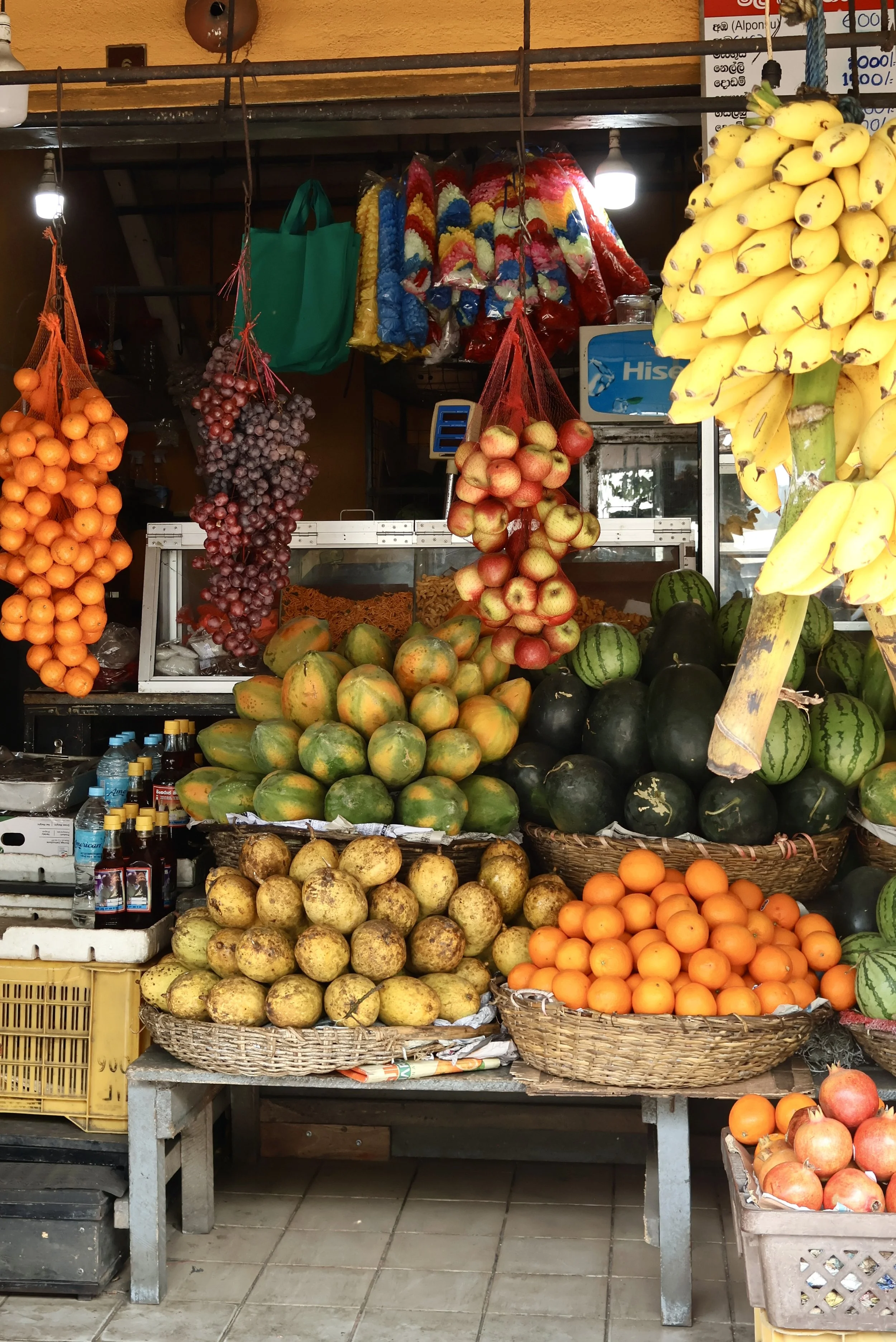
Galle fruit market, Sri Lanka
In Sri Lanka, mango is readily available, but it’s much more floral in flavour. Something to be savoured rather than devoured.
Banana dominates here. Hanging from every nook and cranny of a stall. Big ones, little ones and even red ones. Sweeter and creamier than those I’m used to at home. A visit to the fruit vendor here often results in a free sample pressed into your hand as you navigate the busy streets.
Daily fruit stall rituals
Back at the fruit stall, the elderly Sri Lankan man is hacking away at a papaya, revealing pale orange flesh that reminds me of the hues of the sun setting over the Indian Ocean. The dark brown seeds are scooped away and forgotten. Eating the cool papaya feels like the perfect antidote to the most humid of days.
The stall holder hands us our clear plastic bag of fruity goodness, sticky to the touch. We pay and dodge our way back past a mound of bananas on the floor.
Another deal done. Another bag of tropical goodness secured.
The daily ritual of the fruit stall isn’t always pretty, but it is always rewarding.
If you enjoyed this, you might like the below too…
The ceiling fans whip above our heads at an alarming rate, trying to keep pace with the mid-afternoon humidity as those of us sampling afternoon tea on the veranda at the Amangalla Hotel in Galle attempt to tread the fine line between refinement and simply keeping cool, all while downing cups of hot tea.
It is a slightly nostalgic afternoon for a period of time of which I have no living knowledge. Anemoia, as my musician friend Yarni would say.
The building itself has lived several lives. Once the headquarters of the Dutch East India Company, later Galle’s first hotel under British rule, and now a quietly polished luxury stay.
Like many places on the island, Sri Lanka still carries clues of its European colonial past.