Writing
Having a third space is having a place outside of your home or workplace to convene or to relax. It might be purposeful, like a pub or a café. Or it could be something less obvious, like a park or a beach.
On a flight from Kuala Lumpur to Cebu, I look down and spot a cluster of small tropical islands off the coast of Borneo. All green jungle, ringed by white sand and clear turquoise water.
The ceiling fans whip above our heads at an alarming rate, trying to keep pace with the mid-afternoon humidity as those of us sampling afternoon tea on the veranda at the Amangalla Hotel in Galle attempt to tread the fine line between refinement and simply keeping cool, all while downing cups of hot tea.
When travelling, there’s a long list of advice people give about how to find a good place to eat. But I’ve never seen anyone say what I am about to reveal…
A loud rumble of a vehicle passes close to my right side as I walk along the dusty, dry street, narrowly avoiding uneven slabs of pavement and stepping over open drain covers.
Long before the crowds and chaos, there is a moment of calm. A stillness. An unexpected beauty.
It’s hot and humid and we are stood uneasily inside a badly lit shop. Sharp knives are carelessly left on any flat surface that can be found. A large spider crawls up a wooden beam directly behind my wife and settles, part-camouflaged beneath a heap of pineapples.
Each day, everywhere in the world, the sun will set (extreme solstice points notwithstanding). Sometimes it’s visible, other times it’s hidden behind a thick blanket of overcast sky. On the motorway, outside your home, or at the beach.
I interrupt my usual travel writing (no, this is not a travel blog) with something closer to home. Pizza.
I am now in Koh Kood and shifting here has been a change of pace. After the bustle of Bangkok, and the constant movement of travelling through Australia, it’s been quietly comforting to spend a couple of weeks in one spot. To wake up without needing to think too far ahead. To let the days arrive as they are.
Familiar unfamiliarity is often a feature of travel. A trip to New York turns a lifetime of television and film into reality. Manhattan becomes a walking set of “wasn’t this in…” and “isn’t that where…”. Paris and Rome carry a different kind of recognition, the inherited romanticism of the Seine or the Trevi Fountain, places we feel we already know long before we arrive.
The sun rises above the horizon, spilling gold across the sea and over the hundreds of pilgrims gathered at the Byron lighthouse. A middle-aged Italian man begins singing the opening lines of My Girl. Not an obvious soundtrack for a warm, cloud-free January morning, but a welcome one nonetheless.
Usually, a rainy day would put me in a bad mood. Perhaps surprising, given I come from the north of England, but it’s never something one really looks forward to, especially when travelling in the hope of sunny climes.
Eating out is one of the great joys of travel. I love food and I love trying as broad a range of things as possible while away, ideally local and ideally seasonal. We spend a lot of time planning what and where to eat on our trips to make sure we experience the best and most authentic food a place has to offer.
We take a left from the busy streets of the market. Catania is as edgy as I recall - the dark grey buildings, narrow streets and looming Mount Etna giving it a totally different feel to the baroque hillside towns of the Val Di Noto, where we have just come from.
Of late this blog has gotten a little travel heavy and that’s because of course, I am travelling. However, I’m acutely conscious that this is not a travel blog. There’s no intent to unseat Lonely Planet in telling you where to go, what to do, or what to think.
Some foods find you. Others you have to hunt for. Scaccia belonged firmly in the second camp. I first came across it years ago, in a newspaper article I read.
Departing town and dodging Fiat Pandas making illegal, yet excruciatingly slow, turns. A BMW fails to stop at a stop sign and I am grateful to be on high alert. Cars sit double parked along the pavement, blocking a lane of traffic. It is apparently fine because the hazard lights are on.
We’re driving through the outskirts of Trapani. A rain shower passes over as quickly as it came, a common theme for this part of the north western Sicilian coastline in late November. The windscreen wipers begin to slow and the sun shines bright, glistening off the road.
Anthony Bourdain once said that the real heart of a place is found in its markets and that if you want to understand a culture, you should go where people shop and eat every day. I have always agreed with him. Whenever I travel somewhere new, the market is my first stop.
Our plane begins its descent into Palermo. The curve of the bay glows on our left, a soft necklace of lights against the dark water, while the mountains stand brooding around the city.
I’ve recently been watching Jimmy McGovern’s Accused on Netflix. This drama from the early 2010s sees each episode focus on a trial, at court. The crimes committed in each episode vary, but the consistent theme of each challenges the viewer’s perception of morality, versus the law.
If you’ve been wondering about the splash of pink across Passeggiare, here’s the story.
The inspiration comes straight from Italy’s most iconic newspaper: La Gazzetta dello Sport. I didn’t want this to look like just another blog - the choice of pink was deliberate, a nod to something uniquely, unmistakably Italian.
Strong Women - Sukarara weaving village
After enough time on the road, travel stops being about places and starts becoming about perception. Not what you see, but how it quietly rewires what you thought you knew.
After enough time on the road, travel stops being about places and starts becoming about perception. Not what you see, but how it rewires what you thought you knew.
I’ve felt that in many places and I felt it last in Sukarara, a weaving village in Lombok, where our driver pulled in on our way to Tetebatu - rice country.
Lombok is a predominantly Muslim island and before coming here I carried a loose, untested assumption. That women would be less visible. More hidden. That life would feel, in some way, constrained.
It didn’t take long for that to fall apart.
Our guide - Rhianna
We were shown around by our host, who introduced herself as Rhianna. Around her were Beyoncé, Taylor Swift, J.Lo, Ariana Grande. Not names given to them, but names they had chosen themselves, worn lightly, almost as a joke shared with the world passing through.
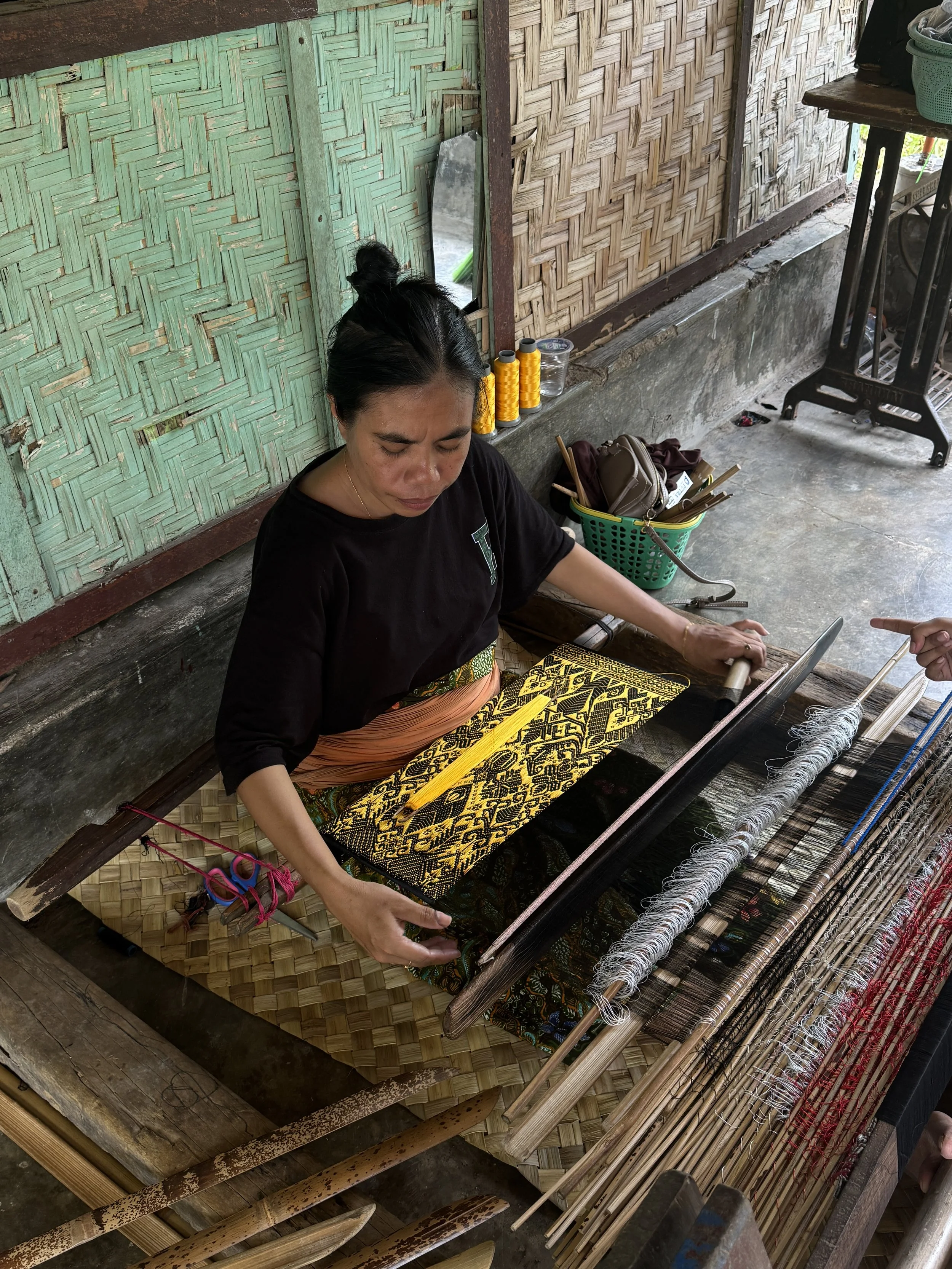
We pass outside a small house with a structure full of looms, sitting alongside a small platform where one of the village women (Ariana Grande) sat tirelessly working away, methodically building patterns with cotton and silk.
Nearby, Taylor Swift sits upright at the loom for hours each day, even in the heat of noon. Bamboo dowels clack softly as she works, adjusting the pattern thread by thread. It’s precise, repetitive work.
Intricate hand weaving in action by Ariana Grande
Even here, in the middle of it, she turns to my wife and asks if she knows Adele, after finding out we are from England. When she says no, Taylor Swift laughs and starts singing anyway - Someone Like You. Just the chorus. The two of them sing it together, half serious, half joking, while a pair of chickens wander past across the dry, dusty ground.
The loom doesn’t stop and the rhythm holds.
At one point, one of the older women (no stage name provided) tells me her niece wants to go to university. It’s too expensive. Schooling, she explains, doesn’t always stretch as far as ambition here. She hopes that might change.
She says it simply. Not as a complaint. Just as a fact.
It stays with me. Not as a judgement of the place, but as a contrast. A reminder of the things I’ve taken for granted. Of how differently life can branch depending on where you begin.
What struck me most wasn’t that this overturned everything I thought about Islam or Indonesia. It didn’t. That would be too neat. Too easy.
Sukarara weaving village, Lombok, Indonesia
But it did challenge the version I’d been carrying.
Because what I saw wasn’t oppression, or at least not in the way I had imagined it. What I saw were women with agency, organising, joking, hosting, holding the space. Visible in it. Comfortable in it.
Strong, not in a dramatic sense, but in a steady, everyday way.
It didn’t rewrite the whole story. But it changed the tone of it.
And that, more than anything, feels like the real gift of travel.
If you enjoyed this, you might like the below too…
The ceiling fans whip above our heads at an alarming rate, trying to keep pace with the mid-afternoon humidity as those of us sampling afternoon tea on the veranda at the Amangalla Hotel in Galle attempt to tread the fine line between refinement and simply keeping cool, all while downing cups of hot tea.
After enough time on the road, travel stops being about places and starts becoming about perception. Not what you see, but how it quietly rewires what you thought you knew.