
The Accidental Travel Influencer
I had a random thought the other day. Ironically, it involved Karl Pilkington.
In a world of endless “Top 10 things to do in…” lists and “Come with me for a day…” videos, Karl Pilkington may have accidentally become one of the most useful travel influencers of the modern era. Which is unfortunate, because he’d probably hate being described that way.
Filmed between 2010 and 2012, An Idiot Abroad arrived just before influencer culture truly took hold. Instagram was little more than a place to share photos. TikTok didn’t exist. YouTube was somewhere to watch old music videos and the occasional funny dog clip. The premise was simple. Ricky Gervais and Stephen Merchant sent their friend Karl around the world, placing him in situations ranging from mildly uncomfortable to genuinely absurd.
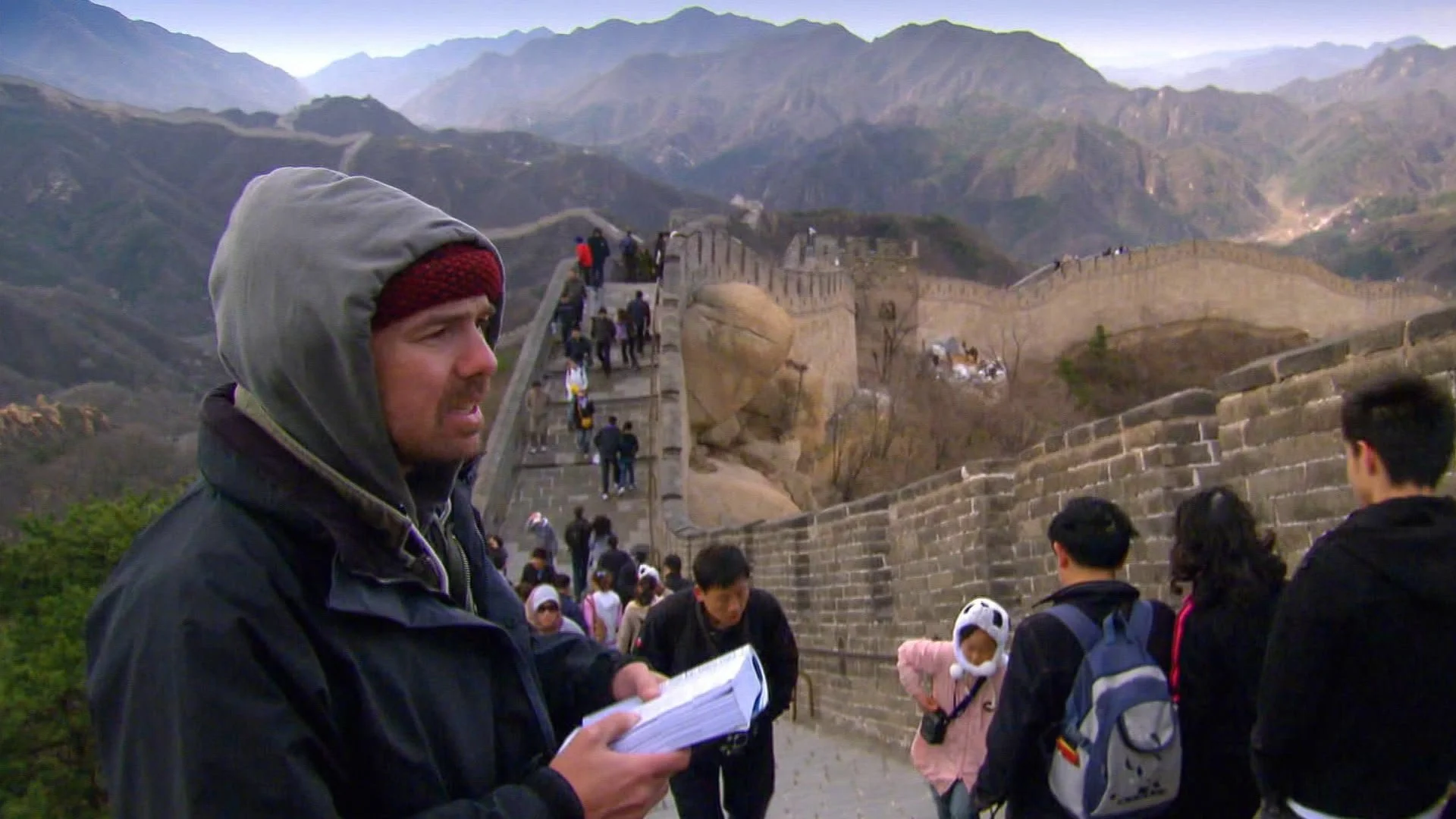
Karl Pilkington at the “All right Wall of China”.
Karl is a self-confessed advocate for the simple life. On one podcast, he spoke about envying old blokes in Italy who seemed content to sit around eating pasta and not doing a great deal else. On another, he explained that he and his long-term partner Suzanne enjoy visiting graveyards on holiday. His simplicity is often ridiculed. Sometimes fairly. Sometimes less so.
Yet for all his complaints, Karl repeatedly did things many people never would. He slept in places he didn’t want to sleep, travelled to countries he had little interest in visiting, met people whose lives were entirely different to his own and threw himself into situations that genuinely frightened him. For someone who constantly claimed he wanted an easy life, he spent a surprising amount of time pushing himself outside his comfort zone.
The difference was that he never pretended to enjoy anything.
When An Idiot Abroad was made, travel occupied a different place in the culture. You went away, found some places you liked, came home and uploaded 487 photos to a Facebook album. The modern traveller is often encouraged to become a collector. Collect the attractions. Collect the ‘hidden gem’ restaurants. Collect the ‘secret’ beaches. Collect the photographs proving you were there.
Entire queues form so people can take the same photograph in the same spot as thousands of others before them. Entire destinations can feel as though they arrive pre-packaged, complete with a list of approved experiences and mandatory stops. The irony is that the more people follow the same patterns, the more similar their journeys become.
Much of modern travel content assumes certain experiences are inherently wonderful because social media has collectively decided they are. Karl Pilkington, meanwhile, turns up at the Great Wall of China and declares it the “All right Wall of China”.
It’s a ridiculous observation. But it’s also a useful one. Because Karl gave himself permission to have his own reaction.
Sometimes the answer is that an experience really is extraordinary. Other times the answer is that we’re doing something because we’re supposed to.
One of my favourite examples comes when Karl visits the famous Taj Mahal bench where Princess Diana sat following the breakdown of her marriage to Prince Charles. Tourists queue up to sit on the exact same spot. Karl points out that it’s impossible to have an emotional experience there with so many people around. He then speculates that Diana wasn’t looking sad because of the breakdown of her marriage at all. She was probably just fed up of India and had diarrhoea for three days.
It’s a funny conclusion. Yet buried beneath the joke is an interesting observation. Travel experiences often arrive with emotions already attached to them. We’re told how we’re supposed to feel before we arrive. Karl never seemed especially interested in following the script.
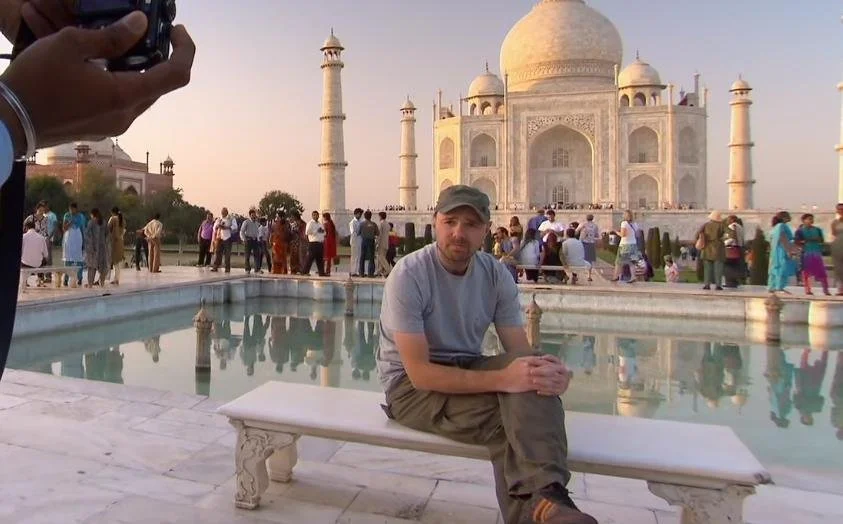
Princess Diana pose, Taj Mahal, India.
What Karl understood, perhaps accidentally, is that travel isn’t always about the headline attractions.
In Israel, he appears far more affected by passing through security checkpoints than by standing at the alleged birthplace of Jesus. In Egypt, he’s fascinated by the chaos of the traffic and questions the song Walk Like an Egyptian given all the locals are driving and beeping their horns.
For all the jokes, Karl is often more interested in people than places. He repeatedly drifts away from the attraction itself and towards the lives unfolding around it. How people work. What they eat. Whether they’re happy. How they spend their days.
One of the most telling moments comes when he’s staying with a Mayan family in Mexico. After trying wasp larvae, Karl decides it’s only fair that the exchange goes both ways and offers them some Monster Munch. It’s an interesting image, but also a revealing one. Karl’s best moments rarely happen at the landmark itself. They happen when he’s talking to people, asking questions and trying to understand how they live.
In fact, Karl is often more open-minded than he’s given credit for.
At Chichén Itzá, he admits he’s spent much of the trip moaning about the world’s wonders. Having tried new foods, slept in unfamiliar places and pushed himself outside his comfort zone, he decides to approach this one differently. He wants to give it a fair chance.
Whilst there, Suzanne calls and asks what it is like, he sums up this Seven Wonder of the World as “It’s alright, yeah. Just a big pyramid” before moving the conversation back to helping her connect the DVD player to the television.
It’s a perfect Karl Pilkington moment. He tries. He engages. He just refuses to pretend.
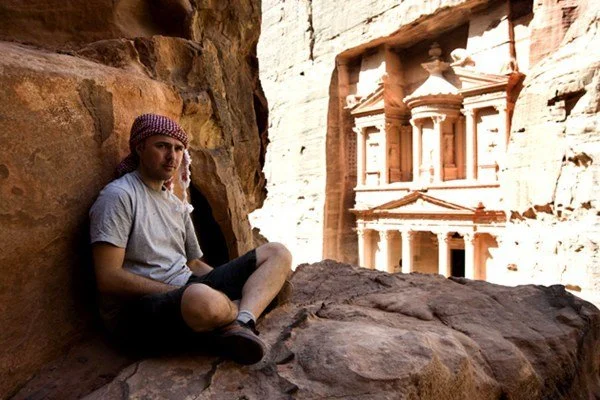
Karl Pilkington, Petra, Jordan.
Later in the episode, Karl describes Mexico as the favourite place he’s visited so far. Not because of Chichén Itzá, but because of everything else. The people he met. The places he stayed. The experiences he had along the way.
More tellingly, he says it’s because he felt able to do what he wanted to do.
I think that’s true of travel at its best.
Not following somebody else’s itinerary. Not ticking off the approved experiences. Not collecting photographs purely as evidence that you were there.
Exploring on your own terms.
Travel, after all, is often found in the small moments. The bloke asleep with his gob wide-open on a plastic chair outside a taverna. The strange local election posters lining a backstreet in Bangkok. A conversation with a tuk-tuk driver. A simple sandwich that’s far better than it has any right to be. The details that never make it into an Instagram reel.
The landmarks give us a reason to go. What we remember is usually everything around them.
While everyone else was looking for the world’s wonders and next best thing, Karl often seemed more interested in the ordinary things happening around them. At the pyramids, in Egypt, he notices a tornado of litter whirling through the air and remarks that “you don’t see that in the travel brochure”.
And he’s right. You don’t.
You don’t usually see it on social media either. The tension. The contradictions. The difficult questions that travelling poses. The parts where we’re all, to some degree, complicit.
Karl never really shied away from those things and I think that’s part of what makes the programme feel so fresh all these years later. Beneath the jokes, he wasn’t trying to optimise travel. He wasn’t chasing hidden gems, curating an identity or collecting experiences for an audience.
He was simply reacting to what was in front of him.
An Idiot Abroad seemed an appropriate title at the time.
Looking back, the opposite may be closer to the truth.
The show feels accidentally ahead of its time.
If you enjoyed this, you might like the below too…

After enough time on the road, travel stops being about places and starts becoming about perception. Not what you see, but how it quietly rewires what you thought you knew.