
It’s a Saturday and the cans of beer are in the fridge getting cold for the World Cup quarter-final. England v. Norway. I turn my attention to what I’ll have to eat and I’m in the mood for a kebab. It seems like the perfect pre-match ritual.
England. Beer. Kebab.
A classic trio.
I have recently moved to Poland. I’ve been visiting for years, yet I’m still to have a kebab here, despite how popular they are. Something that surprised me when I first visited.
I message my brother-in-law for advice. Where to order from and what. He promptly points me in the right direction.
Duży amerykański, mięso mieszane i sos mieszany.
Large American, mixed meat and mixed sauce.
New terminology for me, but I trust him and place the order on Uber Eats. Feeling hungry, I even add a portion of fries on the side.
Excitement and anticipation follow. Then, slight apprehension at the thought of doing the handover on the street from the delivery guy’s battered Toyota Aygo. My patchy Polish makes the exchange look like an amateur drug drop-off.
I’m in possession of the package and I am immediately struck by how heavy it is. Have they given me the wrong order?
I get inside and my wife confirms that it is, in fact, normal. Large in Polish most definitely means LARGE.
Learning from past mistakes of my eyes often being bigger than my belly, I cut the kebab in half. I’ll just eat the rest later if I’m still hungry, or better yet, have it tomorrow. One of life’s simple pleasures.
The kebab itself is good. Plenty of meat, a sauce that’s almost like a cross between a burger sauce and a Marie Rose. There are also fries (I needn’t have bought any!), as in a gyros, all wrapped in a grilled tortilla. It’s filling and it satisfies my craving.
Yet, it looks and tastes different from the kebabs I know, with far more sauce. But it gets me thinking about how something so recognisable has established itself in so many different places, with so many unexpected variations.
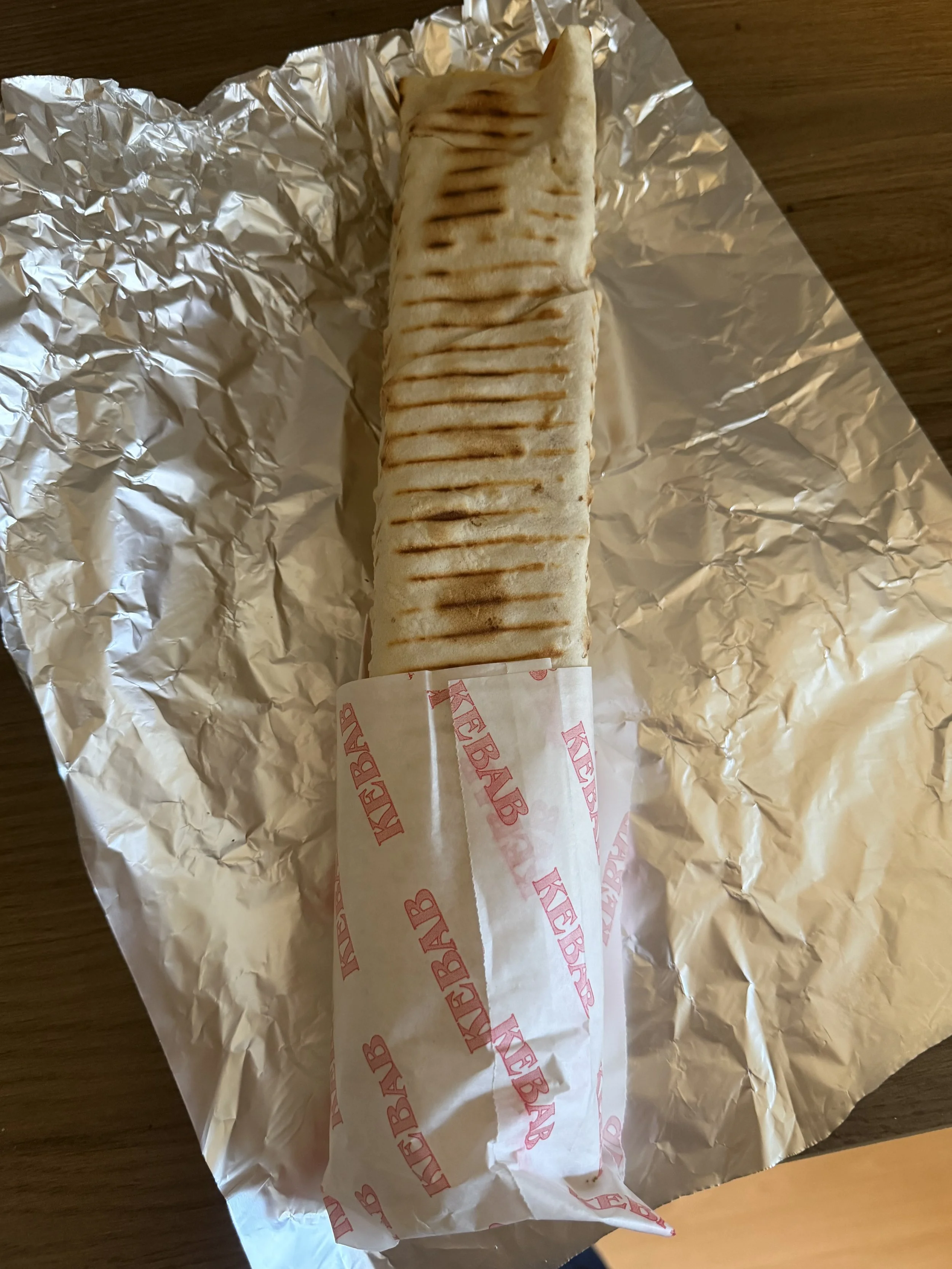
In Poland, large means large. Large American, mixed meat and mixed sauce.
Like many Brits, my earliest adult forays into eating kebabs were in the clichéd late-night takeaway, in the early hours of the morning. I might have found myself in Rusholme on the infamous Curry Mile, as a student at the University of Manchester, ordering a kobeda kebab, following a night out in nearby Fallowfield.
A brightly backlit menu behind the counter made my already drunken eyes even more bleary. There’s someone having a fight outside and another person has already dropped their food on the floor, seconds after collecting it from the chirpy, yet not to be fucked with “boss man”.
I stand at the counter waiting for my order and ask the aforementioned “boss man” if it is sumac that’s placed alongside the salt. He’s taken aback at my surprising culinary knowledge; although on reflection I am not sure if it’s for that reason alone, or if it was being able to strike up such a conversation after one too many cheap beers in studentville.
My appreciation for kebabs only grew as my twenties became my thirties, and the search for the best shawarma on London Road, Sheffield, my hometown, became almost as much of a match day ritual as going to the football game itself. Huddled outside of the pub with my mates; pint clutched in one hand and staring longingly across the road at our favourite spot, Middle Eastern Shawarma. Collectively deciding if it was the right time to go and order.
“Will the queue go down if we wait?”
“Are you getting a mixed wrap, or just chicken?”
“Chips too, you fat bastard!?!”
Yet, when I pause to think, it started even earlier. Holidays to Greece as a child meant souvlaki and gyros from inexpensive tavernas and hole-in-the-wall vendors who seemed to be able to wrap the pita bread before you could say “Galaktoboureko”.
I reminisce of a recent holiday on the Greek Island of Sifnos, with my wife and an evening at the massively, yet rightly hyped, Cantina. Casual fine dining and difficult to get a table; yet one of the courses is a swordfish gyros. Refined, but without losing its substance. The swordfish cooked on the grill, fully licked by the smoke. Offset against the cold, soothing tzatziki.
Different kebabs, for different needs.
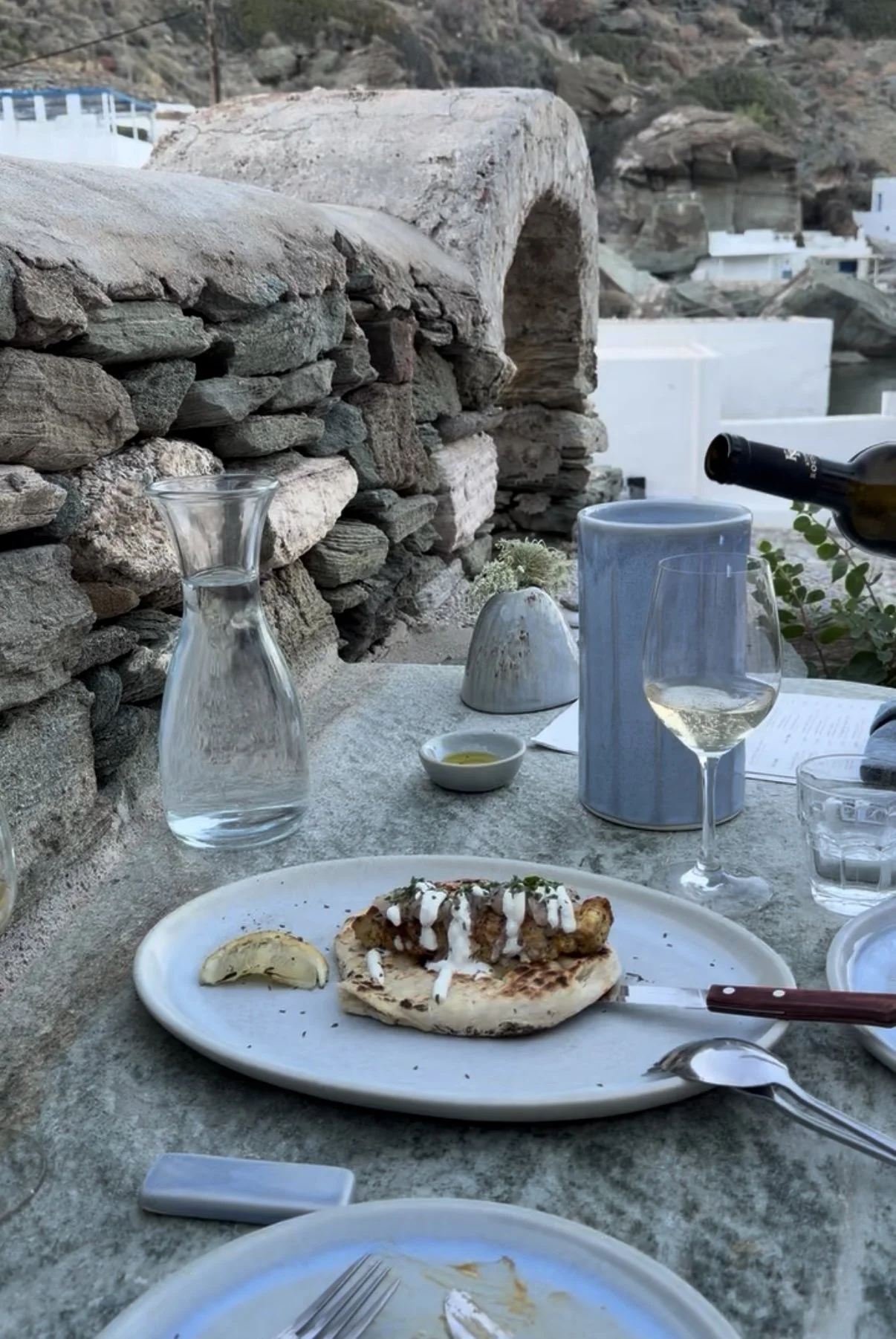
Elevated gyros - Cantina, Sifnos, Greece.
I guess this is why kebabs remain so compellingly popular, irrespective of status. They draw on familiar elements: flame, smoke, seasoning, bread, and hands assembling them in slightly different ways.
It’s elemental. The cooking can be both technically and culturally sophisticated, whilst still being instinctive.
Maybe it’s food being cooked over a fire that attracts people? Each adaptation gives those familiar elements a different form.
It can be affordable, filling, easily available and eaten without ceremony, as in those late-night encounters on the way home.
Maybe the greatest leveller of the kebab, though, is personal choice. The protein, the bread, the vegetables, the sauces, the size and the format can all be adapted to suit different tastes and desires.
Don’t eat meat? No problem. Don’t like onions? Fine, leave them off.
Eating a takeaway kebab requires little etiquette (it’d be impossible to observe much in some circumstances!), nor does it require much specialist knowledge or a dress code.
You don’t even need a reservation to eat one, unless you want to try a critically-acclaimed version at somewhere like Berenjak in London - holder of a Michelin Bib Gourmand and notoriously difficult to get a table at; unless you are happy to take your chances waiting a few hours for a walk-up table at the counter.
The kebab is not totally untouched by class, but it can still travel across different worlds without losing its core identity.
I struggle to think of many other foods that move so freely between the different settings in which I’ve eaten them.
The tradition of cooking seasoned meat over fire is much older than any of these meals. The kebab’s history reaches across Persian, Turkic and wider Middle Eastern food cultures.
Trade routes east and west, military invasions and migration have all contributed towards spreading its reach.
As people have moved, they have taken their food with them. Immigrant cooks and shopkeepers have adapted and shaped what a kebab can be, depending on local ingredients, tastes and economics.
Local versions can come to feel as familiar as dishes that have been there for generations.
It is paradoxical, but the kebab’s consistency comes from its adaptability. It does not remain unchanged, yet it always retains its recognisable principles, while allowing almost everything around it to evolve.
Back in Poland, it may surprise an outsider that kebab shops have become such an ordinary part of life, in a country where Muslims account for well below 1% of the population.
However, the history is deeper than it may appear at first glance.
Poland has had Muslim Tatar communities for centuries. Its food traditions also include szaszłyk, skewered meat whose name has travelled through Russian from Ottoman Turkish.
Modern kebab shops may be more recent, but encounters with skewered meat and related cultures are anything but.
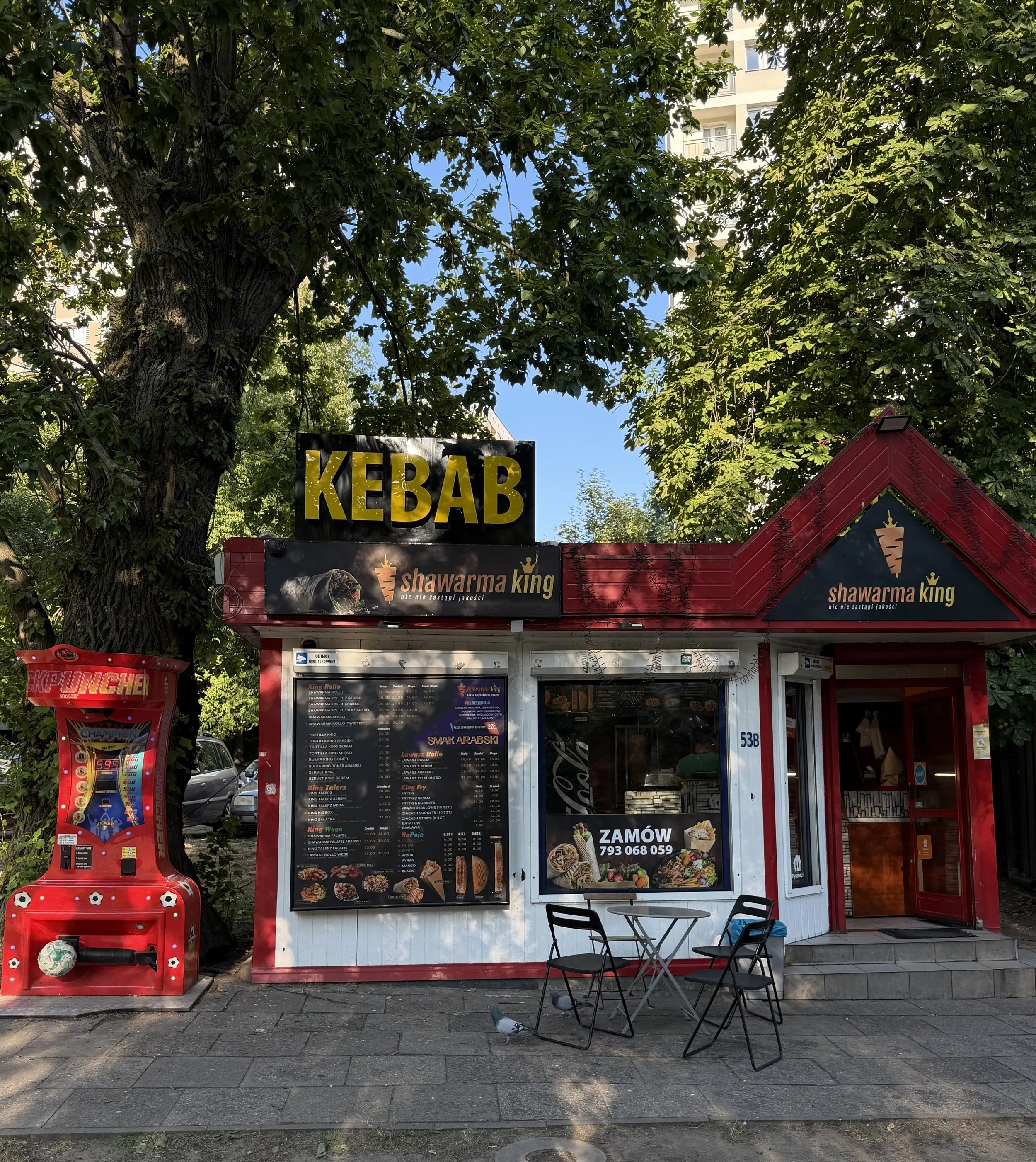
A typical kebab shop found in residential areas of Poland. The addition of a punch machine here, a bonus for some.
The following day, England are through to the semi-final of the World Cup and I triumphantly return to the remaining half of my kebab for a late breakfast, following a late night. I think about how its size reflects the Polish generosity with food I’ve come to know. The kebab has taken on its own conventions and identity here, whilst still remaining the same.
I heat it up in the microwave and take a bite. It’s drier than I remembered it being the night before, yet the flavours seem more intense. I feel no shame in eating a leftover kebab at 11 AM on a Sunday morning. Why should I? I could be anywhere in the world, yet nowhere but here.
If you enjoyed this, you might like the below too…
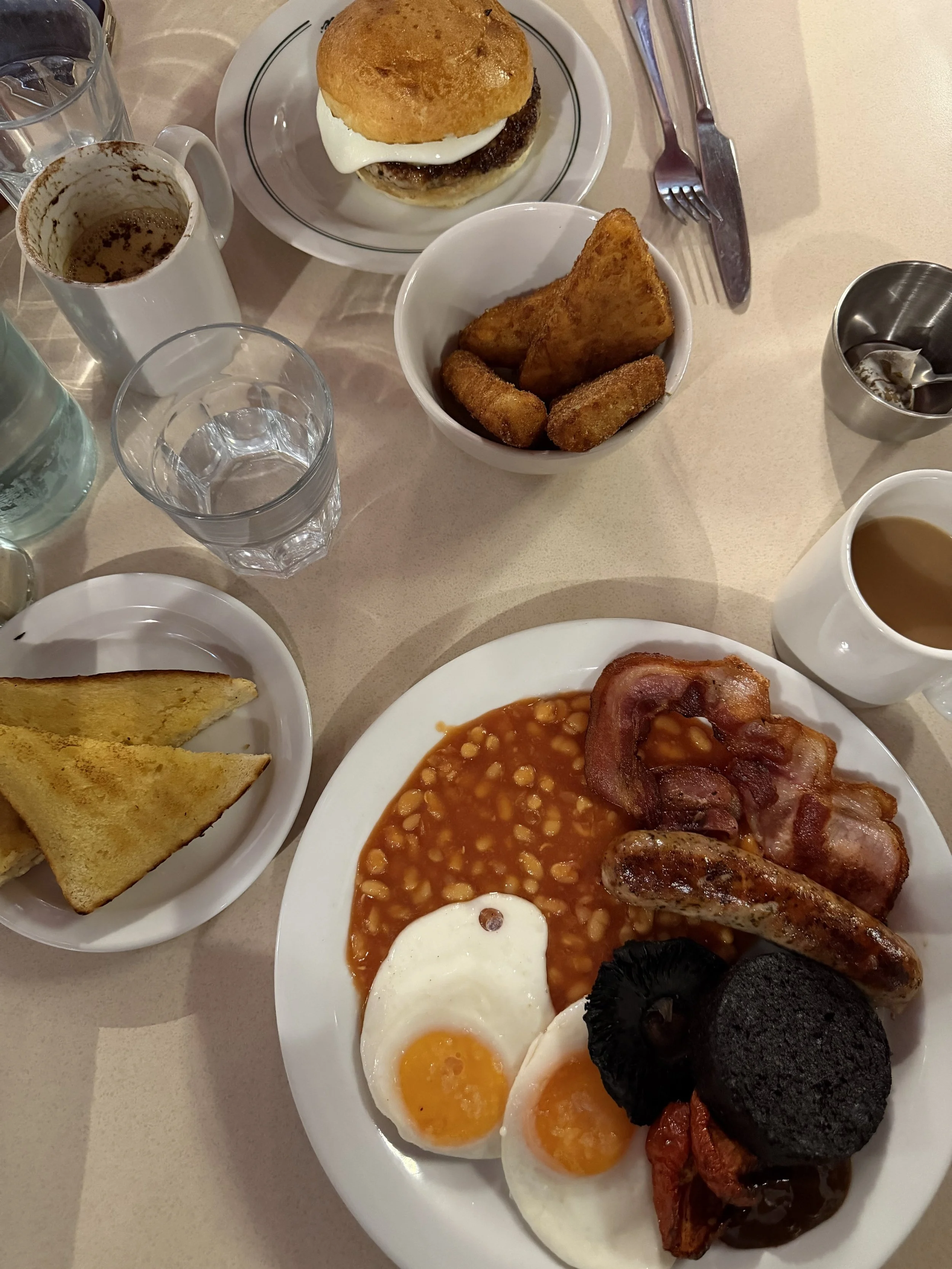

From late-night takeaways in Manchester to matchday rituals in Sheffield and swordfish gyros in Sifnos, the kebab moves between different worlds. An oversized order in Poland gets me thinking about food, class and belonging.